
Tag Archive for: Dr Catherine Farrell

BFBI Business Programme Lead Dr Catherine Farrell CIEEM, Assistant Professor in Business and Nature at Trinity College Dublin, writes on emerging nature-related disclosure requirements and how stakeholder engagement is a key process step in building collective understanding for business and nature, as workshopped with businesses in our Nature Strategy Accelerator Programme, delivered in collaboration with the Deloitte WorldClimate team.

“It was a beautiful autumn day when our group met in the Deloitte offices in Dublin’s city centre for the last of our three Action Track workshops that focused on the assess phase of the ACT-D framework. In our first workshop, our keen focus was on building an understanding of our value chain – what we do, where – and how that impacts on nature and, importantly, how much we depend on nature.

Too often businesses are experiencing chinks in the flow of essential components of their supply chains due to a fault in a lengthy global chain, with many of those faults related to climate and biodiversity related risks. If we understand these aspects, we can begin to address ways (opportunities) to mitigate those risks.

The next step is to take a metaphorical LEAP (literally: Locate, Evaluate and Assess our impacts, dependencies, risks and opportunities, and then Prepare to report) and draw a map whereby we can begin a deeper dive and evaluate and assess those dependencies, risks and impacts.

But as we draw that map, we must take time to draw out what stakeholders matter, where, and why. Thanks to the Deloitte team for outlining key stages in a stakeholder engagement and communications plan. Stakeholder engagement isn’t just an option – it’s fundamental to being part of a global community, expressed through global and local links in our value chain.
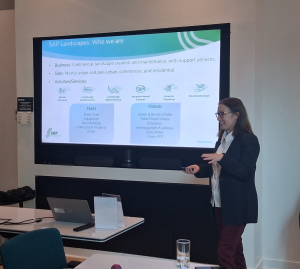
Woman speaks at large screenshowing text in blue boxes and small icons

Under the Corporate Sustainability Reporting Directive (CSRD), Taskforce on Nature-related Financial Disclosure (TNFD) and other guidance such as the Global Reporting Initiative (GRI) and ACT-D, (Assess/Commit/Transform/Disclose), stakeholder engagement is essential for a thorough Double Materiality Assessment process, and critical to any business’ local and global reputation. We were fortunate to have Janice Leonard of SAP Landscapes, above, a business in the next track up, Strategy, present her own journey through DMA and stakeholder engagement, bringing a real-world / learning-by-doing perspective. The SAP Landscapes journey is inspiring, and we all benefited from Janice’s insights, which included the need for steady dedication and the benefits of drawing on the Business for Biodiversity Ireland community within the Nature Strategy Accelerator Programme.

While there is a steep learning curve for many businesses in building awareness and understanding in relation to biodiversity and ecosystems, and the role business is poised to play in driving Nature Positive ambition, Business for Biodiversity Ireland is a reliable support to help businesses of every size and sector work through inter-connections and complexities.

Thanks to all our Action Track businesses for their generosity in sharing their own journeys and we look forward to working with you on the Strategic next phase. Thanks to SAP Landscapes, CIÉ, CIÉ Tours, Cloud Assist, Dublin Airport Authority, FuturEnergy Ireland, Irish Rail, Irish Trees, Scott Cawley Ltd, Shannon Airport, Trinity College Dublin and Watermark.

Business for Biodiversity Ireland is delighted to once again be partnering with the Business Post ESG Autumn Summit, on Thursday, November 20th in Croke Park, Dublin. BFBI Business Programme Lead Dr Catherine Farrell CIEEM, Asst Prof at Trinity Business School, will be moderating the deep dive panel on Making the Business Case for a Nature-Positive Future, alongside John Barcroft, Sustainability Consultant at The Environmental Edge.

Regardless of the ESG pushback in some quarters, the reality is that all businesses will be required to decarbonise and reduce their impact on the planet as climate and nature-related shocks such as weather extremes and disrupted supply chains become more frequent. ESG is no longer just a compliance issue – it has become a core part of business strategy. This ESG Summit offers a platform for dialogue, innovation and action in addressing the challenges facing today’s businesses and sustainability professionals. Join business leaders, forward-thinking organisations, policymakers and changemakers for practical strategies to navigate regulatory changes, acquire actionable insights and build valuable networks. View the agenda HERE.

The BFBI Team will be here hosting an exhibition stand to discuss how we can help Irish businesses to tackle all of the above – come and ask us about our Nature Strategy Accelerator Programme!

Discounted Ticket Offer: As part of our partnership with the Business Post’s, ESG Summit, get a 15% discount on the standard ticket price by using the discount coupon code BIO15.
(If you require any further information or require assistance with your booking, you can contact Jackie Bryan on 00353 87 0557913 or on email: jackie.bryan@businesspost.ie)

Register for the ESG Autumn Summit HERE.

Would you like to participate in The Business of Nature Positive?

BFBI Business Programme Lead, Dr Catherine Farrell CIEEM is an Assistant Professor of Business & Nature at Trinity College Dublin. This past academic year in Trinity Business School, she and a group of students engaged with businesses from a broad range of sectors in Ireland for a new module, The Business of Nature Positive.

From SME to major legal firms, to real estate to aviation, 34 students worked with 15 businesses to build understanding of their impacts and dependencies on nature, and how they can address nature-related risks, as well as explore opportunities through nature-positive actions. You can read more about the module, which is supported by the Business for Biodiversity Ireland team, here, and sign up after reading the full Expression of Interest document below.

Here are some of the testimonials from the Sustainability Champion Leads that engaged with us this year to inspire you to participate – whether your business is just one person / a small team or large scale, size does not matter:

Engaging with the students through the course was valuable to us as it provided an impetus to tackle the real challenges we must overcome. Coming from outside our domain was also useful as they were able to provide a different perspective. – Jane, Trinity College Dublin.


This was a really rewarding experience. The module was run very professionally and the students’ level of engagement exceeded expectations, as did the output which will be very complimentary to our sustainability strategy around biodiversity. – Neil, Hibernia Real Estate.


Working with our students helped put our efforts and plans into perspective… Their ideas to expand nature-positive businesses – especially their most simple ideas – have inspired. – Patrick, Notre Dame Dublin.


I would definitely encourage any business to get involved, the students have so much knowledge and come with lots of ideas about embedding sustainability. The end report is written specifically for your organisation which was insightful and well written. Overall, a great experience and hopefully the students thought it was useful too! – Dee, Chartered Accountants Ireland.


A very positive experience, as the students were really engaged and interested. I think they learned a lot from this initiative, as did we! – Megan, Native Events.


It has been a great pleasure working with the students and collaborating with Dr Catherine Farrell. Viewing our business from a different perspective has been incredibly valuable. We hope The Shannon Airport Group can continue to collaborate with Trinity College in the future. – Arek, The Shannon Airport Group.


It was a pleasure to work with the students of the Business of Nature Positive module at Trinity Business School under the guidance of Dr Catherine Farrell. The programme provided me with hands-on practical experience … and the resulting report will be a very useful tool in our biodiversity strategy for the future. For businesses that have not yet started evaluating their biodiversity-related impacts, risks and opportunities this is a valuable programme and one I can highly recommend. – Lorraine, A&L Goodbody.

The call for businesses to engage with this year’s student (academic year 2025-2026) is now open – an opportunity for you to learn more about sustainability reporting for your business – read the Expression of Interest PDF linked below with full details of what’s involved below and sign up HERE.

Poster in dark red with white text and logos

Expression of Interest: TBS Nature positive module 4_6_2025

BFBI Business Programme Lead Dr Catherine Farrell CIEEM, Trinity College Dublin, writes on the process steps around undertaking a Double Materiality Assessment (DMA) to help guide your nature strategy: this article focuses on the ways to understand how businesses interface with nature, highlighting the data needs but also the language of a DMA.

Following from our inspiring and interactive workshop on March 10th (read about it here), alongside colleagues from Deloitte, the Business for Biodiversity Ireland team led the second of our Action Track workshop series on May 20th. While our initial workshop focused on the key elements of what a Double Materiality Assessment (DMA) is (and/or isn’t), especially the value chain, this time we focused on how we can map and track the interface of business with nature.

This involves homing in on ‘the where’ part of the DMA process. In essence, this means gathering your organisation’s location data like maps, and – in tandem – figuring out the other types of data available, what they measure and why. Then its time to focus on how we might use data (which may be freely available as well as company-held) to inform our DMA. Our colleagues from Deloitte shared their DMA journey, highlighting how tools like the TNFD LEAP (Locate, Evaluate, Assess and Prepare), can help bring understanding of our business interfaces with nature to light.

In this article we focus more on data and the language of data and DMA (beware of the acronyms!):

Data: we hear a lot about data these days, but when we’re trying to understand our business impacts and dependencies (how we rely on nature) we really need to focus on data relating to aspects of nature referenced in the nature-related reporting frameworks like CSRD, TNFD, SBTN and GRI.

We can start by breaking these into –

  • Locational data (a map of where we operate – note, start with one part of your value chain and get the hang of it!)
  • What types of habitats or ecosystems are present in those places (the basic type and their extent)
  • What our impact is on these specific areas of ecosystem (how we influence their condition), and
  • How we rely on them (what we need from these ecosystems as inputs, aka ecosystem services to our operations) or impact them.

This helps us Locate, Evaluate and Assess our impacts, dependencies, risks and opportunities, and then Prepare to report (think LEAP). We can do this by using available data on habitats, but -now, a health warning – in Ireland habitat data is quite limited. With some ecological input to help, however, we can gather up what is available, in a useful way.

Language: ecological and nature lingo is nuanced but not beyond our reach. It’s helpful to have someone working with us that can communicate these nuances in a clear, simple way. During our workshop we discovered that acronyms and strange ‘eco’ languages can be off putting initially, but once we get into the flow, we find what we need to know.

Many thanks to Aoife Connaughton and Deloitte for collaborating on this workshop, National Biodiversity Data Centre’s Sarah Kelly, and all our Action Track businesses for participating in our Nature Strategy Accelerator Programme, including CIE and CIE Tours, Cloud Assist, Irish Rail, Irish Trees, Future Energy Ireland, KMK, Scott Cawley Ltd, Shannon Airport, Trinity College Dublin and Watermark Coffee.

BFBI Business Programme Lead Dr Catherine Farrell CIEEM, Trinity College Dublin, writes on the process steps around a Double Materiality Assessment to help guide your nature strategy, the subject of our recent Action Track workshop.

As the birds have started to sing for us every morning again (what a joy!), it’s the right time for our businesses to spring into action. And so, inspired by the stretch in the days, on March 11th the team at Business for Biodiversity Ireland, with help from our friends at Deloitte, launched the first of our three Action Track workshops scheduled for 2025 in Dublin.

Our workshop focused on the key elements of what a Double Materiality Assessment (DMA) is (and isn’t), and why it makes perfect business sense for every organisation to conduct one. Business for Nature has outlined how we can do this through a multi-step, iterative process under the Assess phase of their ACT-D framework

Reporting frameworks and sectoral guidance: With heads spinning after the recent EU Omnibus proposal announcement, we all agreed at the workshop, that even though reporting obligation ‘goal posts and timeframes may change, it’s in everyone’s best interest to understand a) their impacts on nature, and b) nature’s impacts / on our businesses (which in turn, relate to dependencies, but also risks and opportunities). This ‘inward and outward looking’ approach is what puts the ‘double’ in DMA. Thankfully, there is a growing repository of sectoral guidance and case studies, as well as freely available online tools like ENCORE and IBAT that assist businesses to begin the journey of ‘Assess’ with relative ease. In the workshop we talked through CSRD, TNFD, SBTN and GRI, but we reminded ourselves, at the heart of all these frameworks is rolling up the sleeves to understand our business operations, our extended value chains and who we interact with along the way.

Value chains and stakeholders: In a world of global value chains – where does a value chain start and end? We spent a fruitful and insightful couple of hours working through value chains relevant to our businesses present: it was great to see the emerging pictures on flipcharts, and participate in conversations that really helped our collective understanding to grow – particularly in relation to where our greatest impacts and dependencies may lie. This is a critical part of the DMA process.

Our next two Action Track workshops will build on this work, working through tools like the TNFD LEAP (Locate, Evaluate, Assess and Prepare), to help bring our understanding to light.

A big thank you to our supporters and speakers from Deloitte, Arianna Bunello and Sofia Langs, with  support from Aoife Connaughton and Caitlyn Flanagan, BFBI Head of Operations Iseult Sheehy and Head of Research Dr Emer Ní Dhúill, Sarah Kelly, of National Biodiversity Data Centre, Eadaoin Boyle Tobin, Business in The Community Ireland.

Thanks to our Action Track businesses – Emily Riondato, Kate Farrell and Caoimhe Donnelly, of Coras Iompair Éireann; Ken Lyons, CIE Tours; Aine Kirrane, Dublin Airport Authority, Liam O’Neill (and Sean online) of Cloud Assist; Aoife McGovern, Future Energy Ireland; Ailish Duggan, Irish Rail; Bob Hamilton, Irish Trees; David Finane, KMK; Aebhín Cawley, Scott CawleyLtd; Arek Gdulinski, Shannon Airport and David Lawlor, Watermark.

Sign up for Discovery Track or level up to Action Track in the Members Home to gain access to future workshops.

BFBI Business Programme Lead Dr Catherine Farrell CIEEM, Trinity College Dublin, who presented at our recent Stategy Track workshop in Dublin, recaps on the benefits of developing a Nature Ambition Statement to help guide your nature strategy.

It’s is the perfect time to set targets for the coming year. And so, in the spirit of setting a steady nature-positive pace, the team at Business for Biodiversity Ireland, with help from the Sustainable Futures team at KPMG Ireland, kicked off 2025 with an insightful January workshop for our Strategy Track businesses.

Our focus was on the key elements of what a Nature Ambition Statement is – and why every organisation should have one. BFBI, in partnership with Business for Nature, is hosting the It’s Now for Nature Accelerator programme to empower Irish businesses to develop and publish a credible nature strategy.

Step 1: So, you’ve done your basic value-chain mapping, you’ve identified your main impacts and dependencies, and you’ve found that biodiversity is a material topic for your business to include in annual reporting. In the process, you’ve highlighted key areas to focus on, and you have a sense of what you can achieve. Maybe you also discovered areas that your employees or customers want you to focus on. But you need a North Star to guide your next steps. That is what your Nature Ambition Statement is.

There are some good examples available to learn from, such as the ambition statement developed by Foresight Group, and Business for Nature has provided some good guidance around elements that should be included – such as, how your ambition aligns with the Global Biodiversity Framework targets and timelines for delivery. 

Step 2: The ambition, set out in Step 1, can only be achieved if it is supported by setting targets that can be realised. We need to be thinking about targets that are SMART – specific, measurable, achievable, relevant and time-bound; being clear on what is achievable and within what timeframes. This will be the focus of our next two Strategy Track business workshops coming up later in the year.

In a nutshell, a Nature Ambition Statement sets the coordinates for where your business needs to, and importantly, wants to, go for nature. It can be used to help guide the target-setting process within the company but it also sends a clear, action-oriented message to your customers and key stakeholders. The process itself – agreeing and refining the business’ nature ambition – could also be described as the first step in business transformation.

The next step is getting clear on what the business can do, and what it is ready to commit to, towards a nature-positive future. More on this to come in our next workshop in April.

Our Strategy Track includes pilot BFBI businesses who have been progressing their organisation’s Nature Strategy and sharing feedback along the way, including An Post, Bank of Ireland, Bus Eireann, Cairn Homes, ESB Networks, Gas Networks Ireland, Glenveagh Properties, KPMG Ireland’s Sustainable Futures, SAP Landscapes and our associates at Business in The Community Ireland, Biodiversity Data Centre and Trinity College Dublin.

  • To take the first step on the BFBI 4-Track Nature Strategy Accelerator Programme, your organisation can sign up for our free Discovery Track. Once you have a good handle on what’s needed for your business to begin to take action, you can sign-up to progress along the paid Action Track, then the next step will be the Strategy Track.

Read more here – How It All Works.

Business For Biodiversity Ireland is delighted to announce that Dr Catherine Farrell is moving over from our Board of Directors to take on the role of Business Programme Lead.

A pioneer of ecological restoration and research in Ireland and internationally, having developed Ireland’s first Biodiversity Action Plan for a corporate body (Bord na Móna), Catherine is a Senior Research Fellow in the School of Natural Sciences and Adjunct Teaching Fellow in Trinity Business School at Trinity College Dublin.

Catherine developed a new TCD module for 2024-2025, The Business of Nature Positive, which incorporates learnings about nature, society and economy, exploring ways for undergraduate students to work with businesses in Ireland to support the global Nature Positive Initiative, and report through the Corporate Sustainability Reporting Directive.

Catherine worked on the EPA-funded research project INCASE, applying the UN SEEA Ecosystem Accounting framework at catchment scale in Ireland up to 2022, and her current research as part of BiOrbic National Bioeconomy Research Centre focuses on developing mechanisms to structure, finance, monitor and communicate the direct impacts and broader societal benefits of nature restoration (Project ReFarm).  She was lead organiser of the Peatlands Gathering 2021, and is also a member of the ongoing National Land Use Review process.

Read more on our Meet the Team page.


Business For Biodiversity Ireland is delighted to announce the appointment of a new Board of Directors to guide and inform our work to ensure Irish businesses are ready to join the global push for a transition to a nature-positive economy.

With a climate and biodiversity emergency declared by the Government in 2019, the BFBI platform was seed-funded by the Department of Agriculture and the Department of Housing, Local Government and Heritage in 2021, in recognition of the urgent need for Irish businesses to address their impacts and dependencies on nature. The platform has now developed the Nature Strategy Accelerator Programme to get businesses on track to a nature-positive way of working with up to date guidance on emerging sustainability frameworks and comply with EU directives on environmental reporting.

New Board Chair Susan Rossney, Sustainability Advocacy Manager with the Institute of Chartered Accountants Ireland, said: “A nature-positive economy is vital to our long-term economic resilience – 55% of the world’s GDP is moderately or highly dependent on nature. Despite this, many businesses are unaware of their dependence on and impact on biodiversity, a risk made all the greater now that larger companies are legally bound to disclose information on their environmental impact via the Corporate Sustainability Reporting Directive or CSRD.”

The BFBI Board of Directors also includes:

– Secretary Lisa Davidson, experienced finance and banking professional

– Vice President for Biodiversity and Climate Action and ecology professor at Trinity College Dublin, Jane Stout

– Dr Catherine Farrell, former Bord na Mona ecologist, now Trinity Professor and pioneer of innovative environmental projects including ReFarm and Natural Capital Ireland

– Ken Whitelaw, Sustainability Manager of IDA Ireland

– Asst Prof Kirstie McAdoo of University College Dublin, formerly Airfield Estate

– world-leading biodiversity consultant Edward Pollard, director of the UK Business and Biodiversity Forum, a specialist in demystifying nature for business.

Welcoming the new Board, Executive Director Lucy Gaffney said: “We are thrilled to have such an accomplished team of experts with a wealth of knowledge and experience in business, sustainability and nature restoration.”

Meet the Business For Biodiversity Ireland Board HERE.

Want a deeper understanding of your business’ impacts and dependencies on nature? Wondering where to start with nature-related disclosures? Lost in a fog of TNFD / GRI / EFRAG / CRSD alphabet soup? Keen to develop a roadmap to Nature Positive for your business but don’t know where to start?

Business For Biodiversity Ireland is participating in the development of a new module with Trinity College Dublin’s Dr Catherine Farrell titled ‘The Business of Nature Positive’ and are inviting businesses who would be interested and willing to:

  • participate in Trinity Business School undergraduate / student-led research to trial the application of nature-related reporting frameworks and tools, and
  • explore ways to develop a roadmap to Nature Positive.

Businesses rely on many aspects of nature and climate to carry out day-to-day business. Recognising these dependencies, as well as the impacts of business on nature, new reporting requirements under the new EU Corporate Social and Responsibility Directive (CSRD), will fast become a reality for Irish businesses.

In response to the need to build capacity for present and future business needs, Trinity Business School is developing this module to be delivered to 4th year undergraduates in the 2024/2025 academic year and facilitate learning in how to apply and communicate relevant nature-related reporting and disclosure frameworks for businesses, helping to identify steps to nature positive and through these processes assist businesses to integrate nature into decision making.

We expect the input from the business to be by a nominated staff member / sustainability business champion working directly with the TCD students. We expect the work to involve at minimum approximately 8-10 hours in total over a period of 4 months (largely between December and mid-April 2025 – download a breakdown of time and commitment expected via the PDF at the end of the article.)

As a participating business, through engagement in this process, you will have opportunities to:

  • Benefit by receiving bespoke support in kickstarting scoping for a materiality assessment for your business
  • Assistance in taking the first steps in identifying data available / potential data needs for nature related reporting
  • Develop a deeper understanding of your business’ impacts and dependencies on nature,
  • Begin the thought process as to how to develop a roadmap for nature positive for your
    business, and
  • Trial approaches / identify opportunities for communicating nature related issues to
    stakeholders (internal and external).

Once we have an overview of interested businesses (small or large, of any sector), the module coordinator will follow up with a questionnaire to determine your suitability in terms of logistics and availability.

NB: Please submit an expression of interest form HERE.

This call for Expressions of Interest will close in early July.