
Including ‘Assess’ in your nature strategy: what, why and where?
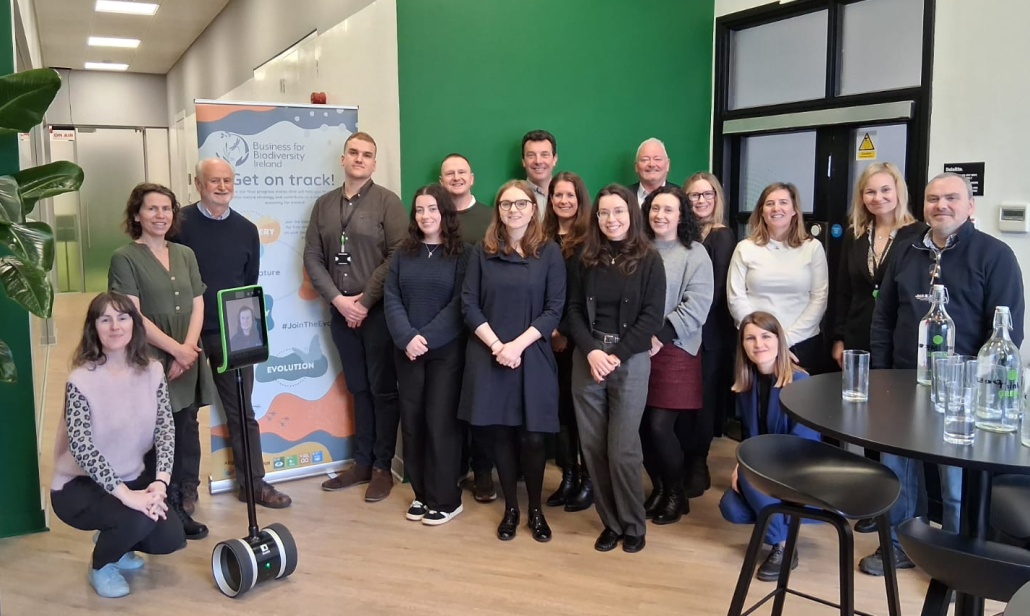
BFBI Business Programme Lead Dr Catherine Farrell CIEEM, Trinity College Dublin, writes on the process steps around a Double Materiality Assessment to help guide your nature strategy, the subject of our recent Action Track workshop.
As the birds have started to sing for us every morning again (what a joy!), it’s the right time for our businesses to spring into action. And so, inspired by the stretch in the days, on March 11th the team at Business for Biodiversity Ireland, with help from our friends at Deloitte, launched the first of our three Action Track workshops scheduled for 2025 in Dublin.
Our workshop focused on the key elements of what a Double Materiality Assessment (DMA) is (and isn’t), and why it makes perfect business sense for every organisation to conduct one. Business for Nature has outlined how we can do this through a multi-step, iterative process under the Assess phase of their ACT-D framework –
Reporting frameworks and sectoral guidance: With heads spinning after the recent EU Omnibus proposal announcement, we all agreed at the workshop, that even though reporting obligation ‘goal posts and timeframes may change, it’s in everyone’s best interest to understand a) their impacts on nature, and b) nature’s impacts / on our businesses (which in turn, relate to dependencies, but also risks and opportunities). This ‘inward and outward looking’ approach is what puts the ‘double’ in DMA. Thankfully, there is a growing repository of sectoral guidance and case studies, as well as freely available online tools like ENCORE and IBAT that assist businesses to begin the journey of ‘Assess’ with relative ease. In the workshop we talked through CSRD, TNFD, SBTN and GRI, but we reminded ourselves, at the heart of all these frameworks is rolling up the sleeves to understand our business operations, our extended value chains and who we interact with along the way.
Value chains and stakeholders: In a world of global value chains – where does a value chain start and end? We spent a fruitful and insightful couple of hours working through value chains relevant to our businesses present: it was great to see the emerging pictures on flipcharts, and participate in conversations that really helped our collective understanding to grow – particularly in relation to where our greatest impacts and dependencies may lie. This is a critical part of the DMA process.
Our next two Action Track workshops will build on this work, working through tools like the TNFD LEAP (Locate, Evaluate, Assess and Prepare), to help bring our understanding to light.
A big thank you to our supporters and speakers from Deloitte, Arianna Bunello and Sofia Langs, with support from Aoife Connaughton and Caitlyn Flanagan, BFBI Head of Operations Iseult Sheehy and Head of Research Dr Emer Ní Dhúill, Sarah Kelly, of National Biodiversity Data Centre, Eadaoin Boyle Tobin, Business in The Community Ireland.
Thanks to our Action Track businesses – Emily Riondato, Kate Farrell and Caoimhe Donnelly, of Coras Iompair Éireann; Ken Lyons, CIE Tours; Aine Kirrane, Dublin Airport Authority, Liam O’Neill (and Sean online) of Cloud Assist; Aoife McGovern, Future Energy Ireland; Ailish Duggan, Irish Rail; Bob Hamilton, Irish Trees; David Finane, KMK; Aebhín Cawley, Scott CawleyLtd; Arek Gdulinski, Shannon Airport and David Lawlor, Watermark.
Sign up for Discovery Track or level up to Action Track in the Members Home to gain access to future workshops.




Trackbacks & Pingbacks
[…] from our inspiring and interactive workshop on March 10th (read about it here), alongside colleagues from Deloitte, the Business for Biodiversity Ireland team led the second of […]
Comments are closed.