It was a week which underlined how much nature has solidified its place on the business agenda alongside climate issues – with the inaugural Carbon & Nature Forum, a Nature Panel at the Business Post ESG & Sustainable Business Summit, BFBI as a finalist at the ESG Awards and our first Nature Strategy Accelerator workshop of the year.

Our Executive Director Dr Maria Fitzpatrick writes:

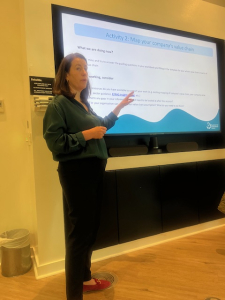
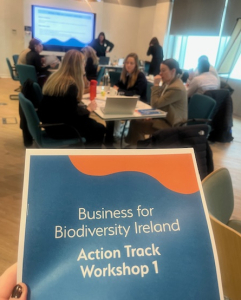
We launched into the second quarter of 2026 with a week of inspiring events that really brought home how much nature is now firmly on the business agenda alongside climate – kicking off on Tuesday, April 14th with our first in-person workshop of 2026 with this year’s first cohort of businesses for our Nature Strategy Accelerator Programme’s Action Track Workshop #1, delivered in association with Deloitte’s WorldClimate Team at their HQ in Dublin.

The focus: getting practical and helping our member organisations identify what’s truly material for them when it comes to reporting and strategy. More on that in future, with two more workshops in the pipeline. Huge thanks to all who participated in an interactive day-long session, to the BFBI team and our new Business Programme Lead Caroline Cawley making her workshop lead debut, to our Business Programme Advisor Dr Catherine Farrell for her continued input into the 2026 programme and to our workshop delivery partners Deloitte Ireland’s Sustainability Leader Caítlín Flanagan for their ongoing support.

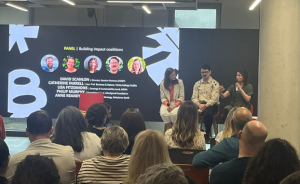
That same day, the first Carbon & Nature Forum at Trinity Business School, hosted by the fantastic BE IMPACTFUL team, brought together a powerhouse line-up, with Asst Prof of Business & Nature Dr Catherine Farrell joining the panel discussions. Huge thanks to Tom Popple, Orlaith Delargy, and Louise French for creating such a valuable space. It was one of those sessions you don’t want to leave (even when your calendar says otherwise). Looking forward to being part of what comes next.

The evening of nature and climate conversations continued at the Climate Heist in The Sugar Club with Climate Cocktail Club – an engaging and thought-provoking mix of music and conversation, featuring voices such as Lesley O’Connor and Aoife O’Leary, alongside inspiring examples of climate innovation and entrepreneurship. BFBI is delighted to get involved in the Climate Cocktail Club’s second annual Climate Carnival ‘From Siloes to Systems’ coming up in September so stay tuned and join the mailing list for more updates on registration and collaboration opportunities. See www.climatecocktailclub.org/events

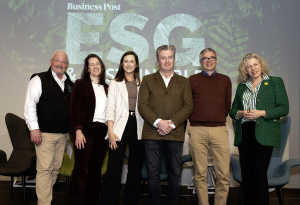
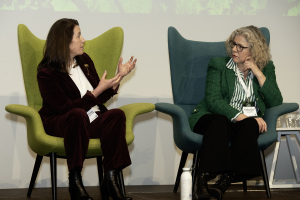
Wednesday took us to the Business Post ESG and Sustainable Business Summit in Croke Park, moderated by broadcaster Philip Boucher-Hayes, where BFBI was proud to take the stage on the dedicated Nature Panel, with Caroline Cawley joining Bob Hamilton, CEO of Irish Trees Ltd, (valued members of our Nature Strategy Accelerator Programme), Dr Siobhan McQuaid of GoNaturePositive!, Horizon Nua, Trinity College Dublin and Stewart Gee, of Climate KIC, and keynote speaker Anne Reaney of Rebalance Earth, sharing insights on how businesses are moving to a nature-positive way of working. Our team, including Research & Tech Lead Dr Emer Ní Dhúill and myself were on hand to chat to delegates at our BFBI exhibition stand. Another day of great discussions, strong engagement, and plenty of follow-ups already in motion.

We wrapped up the week on Thursday, April 16th, as finalists at the ESG Business & Finance Awards 2026 in the Biodiversity Leadership in Business category for the second year in a row. While it wasn’t our day, congratulations to Coillte on a well-deserved win. And a big thank you to Chartered Accountants Ireland and our Chair Susan Rossney for the warm hospitality and great conversations.


Also a big thankyou to our funders National Parks & Wildlife Service and to our associates in KPMG Ireland Sustainable Futures, the National Biodiversity Data Centre, Business in the Community Ireland, Natural Capital Ireland and SustainabilityExamples.com – and to everyone who has been involved in supporting our work helping Irish businesses to integrate biodiversity into business strategy to date.

It’s weeks like this that act as a reminder of just how much momentum is building around bringing nature into the boardroom. So many brilliant people, conversations and ideas – all contributing to what can sometimes feel like an uphill climb but one that’s absolutely worth it.

A strong reminder that progress happens through collaboration, persistence and showing up – again and again.

Ready to show up for nature? Sign up free today to our Nature Strategy Accelerator Programme Discovery Track to access free resources & webinars and take our 10-step module to build your biodiversity knowledge – https://businessforbiodiversity.ie/how-it-all-works/

ESG Summit photos by Maura Hickey

Business for Biodiversity Ireland is delighted to announce that Caroline Cawley will be taking over as our Business Programme Lead.

Caroline, who will be working with our Nature Strategy Accelerator Programme member organisations as they progress through our workshop series for 2026, is a senior sustainability and circularity leader with over 15 years’ experience helping organisations embed sustainability, climate action, circularity, and nature considerations into core business strategy and decision-making.

She has worked across consumer electronics, telecommunications, and environmental services sectors, building and leading sustainability functions, developing materiality-led ESG strategies, targets and reporting frameworks, and delivering Net Zero roadmaps and decarbonisation programmes aligned with the Science-based Targets Initiative. Caroline is recognised for her ability to connect sustainability priorities with commercial outcomes, risk management and long-term value creation. She is also recognised as an expert in fostering circular cultures and ways of working in organisations.

Most recently, Caroline served as Head of Corporate Sustainability at Bang & Olufsen, where she established the company’s sustainability function and integrated circularity, product longevity and climate targets into corporate strategy, financing, governance and product development. She has also held a senior sustainability role with TDC Group in Denmark and with Liberty Global in the Netherlands, delivering commercially impactful initiatives in circular and sustainable product design, eco-packaging, supply chains and energy management.

Caroline holds an MBA from Rotterdam School of Management and an MSc in Environmental Science from Trinity College Dublin. She brings a strong business-led perspective to advancing a circular, low-carbon and nature-positive economy which will be a real asset to the delivery of our programme guiding Irish businesses to boost resilience with a strong nature strategy.

We are also pleased to announce that our previous programme lead Dr Catherine Farrell will be staying with us in the role of Nature Strategy Accelerator Programme Business Programme Advisor.

To begin your Nature Strategy Accelerator Programme with us, register for the introductory Discovery Track HERE.

Or contact ccawley@businessforbiodiversity.ie to discuss your business’ options for our advanced tracks.

The World Benchmarking Alliance (WBA) has released the results of their Nature Benchmark which tracks and measures how 750 of the world’s most influential companies are reducing their negative impacts on nature and contributing to the protection and restoration of ecosystems.

WBA is a partner in the EU-funded GoNaturePositive! project, co-ordinated from Trinity College Dublin,  which supported this independent and scientifically rigorous benchmarking process as part of joint efforts to build an evidence base for transformative change towards a nature-positive economy.

EU companies dominate top performers

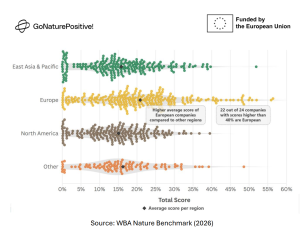
The results of this Nature Benchmark show that EU-headquartered companies account for 11 of the top 20 best performing companies, rising to 18 out of 20 when companies from the UK, Switzerland and Norway are included. Arla Foods from Denmark is the only private company making it into the top 20, with publicly quoted companies making up the vast majority of top performers.

Graph with different colours for each region
WBA reports that across all 750 companies benchmarked, European companies are the global leaders on nature performance, followed by strong performances from South African, Thai, Australian, Japanese and Taiwanese companies. Companies in China, Vietnam and India lag behind, along with those in North and South America.

However, the results also show that the performance bar is low with an average score of 17/100 across all companies, with even the best performing companies scoring under 60/100. Particularly poor performance was noted against indicators which are considered important for transformation towards a nature-positive economy with only 2% of companies disclosing a nature transition plan aligned with the Global Biodiversity Framework or nature-positive principles. These early movers show that some large businesses are starting to embed the concept of nature-positive in their business plans and strategies.

Siobhan McQuaid, Coordinator of GoNaturePositive!, Trinity College Dublin, commented:

“In GoNaturePositive!, we are seeing that while business awareness of nature-related impacts and dependencies is generally low, the financial community and insurance sector are increasingly aware of these risks and are calling for urgent action. We are activating a whole-of-society approach to address these risks – working with businesses, investors, policy makers and communities to accelerate action towards a nature-positive economy.”

Read more on the Nature Benchmark at the World Benchmarking Alliance site.

Need guidance to lead the nature-positive transition in Ireland by developing a Nature Strategy for your organisation? Businesses can now join our Nature Strategy Accelerator Programme, now recruiting for 2026 – sign up here for more information.

Business For Biodiversity Ireland (BFBI) is delighted to announce a new partnership with SustainabilityExamples.com – a collaboration to help our member organisations share biodiversity and climate action initiatives to contribute to collective knowledge exchange to inspire action across the Irish business community.

SustainabilityExamples.com is a dedicated platform where organisations showcase their biodiversity and environmental initiatives in a global community of peers, sustainability leaders, procurement professionals and beyond. It’s a unique space where credible progress is made visible, valued and, increasingly, rewarded through new clients, partnerships, talent, media and potential investment attraction.

Since 2022, Business for Biodiversity Ireland has been driving the transition to a nature-positive Irish economy, where business strategy and activities are geared to enhancing our natural systems and minimising impact, while unlocking opportunity and boosting resilience.

Why our Sustainability Examples partnership matters for our members:

Many companies want to talk about the work they’re doing for nature and climate action but feel hesitant to share “imperfect” stories publicly. This leads to greenhushing, missed commercial opportunities, and slower overall progress. Together, SustainabilityExamples.com and BFBI aim to change that.

The platform is specifically designed to be a safe, non-judgmental environment where sustainability leaders can share their initiatives with likeminded key stakeholders – no algorithms or critics waiting to pounce – but a community who want to share knowledge and constructive feedback, take action and collaborate with others committed to making strides in sustainability, even if still learning. It offers a chance to stand out in a competitive market by publicly sharing impact on an independent third-party platform dedicated to showcasing real, practical, verified progress. There is no time to waste, as we face increasing global supply chain disruption, and insurance and reputational issues, accelerating daily due to climate and nature shocks, with the potential to affect every business, damaging our economy and society as a whole.

Dr Maria Fitzpatrick, BFBI Executive Director said:

“Our Nature Strategy Accelerator Programme members have been working closely with us to develop and hone their Nature Strategy and feed back to us, in an ongoing and transparent process, about the challenges they are facing in developing, monitoring and assessment of biodiversity actions. As they progress, we hope they will take every opportunity to share their evolving nature strategies and concrete actions to protect and boost biodiversity. From the small wins to sharing how your strategic approach to stakeholder engagement, ESG reporting and nature-related risk benefits your business and supports the delivery of the SDGs and nature-positive goals, Sustainability Examples will inform and inspire action and accelerate collaboration for a Nature Positive Economy for Ireland.”

Andrew Sheehan, Founder of SustainabilityExamples.com, said:

“Biodiversity and nature action deserve far more visibility than they currently get, and BFBI has been leading that charge. This partnership gives their members a dedicated safe space to showcase their work, and inspire wider action. Most importantly, publishing their BFBI initiatives helps their members demonstrate real leadership at a time when buyers and stakeholders increasingly expect it. We’re thrilled to welcome BFBI and its members into our community of organisations who are proving that progress – not perfection – is what moves sustainability forward.”

What the partnership means in practice:

  • SustainabilityExamples.com will begin showcasing BFBI’s own offerings, helping businesses better understand nature as a strategic advantage.
  • BFBI members are invited to publish the initiatives they’ve developed with BFBI and beyond – offering real-world examples and giving visibility to a high-intent audience of sustainability leaders, decision-makers and potential partners.
  • SustainabilityExamples.com is free for BFBI members to showcase your initiatives. You can also avail of further promotion of your brand and impact using any of the platform’s paid features at a 15% discount using a unique discount code provided.
  • SustainabilityExamples.com will assist BFBI’s members in crafting the stories they would like to share and amplify to thousands of professionals visiting their platform, newsletter, and social channels, daily.

Unlike other social platforms, SustainabilityExamples.com is purpose-built for sustainability champions. Googled 170,000 times per month globally, the community are engaged and supportive of progress. Sharing your story can lead to:

  • New business conversations
  • Supplier and partnership opportunities
  • Invitations to speak, collaborate or co-create
  • A stronger reputation for leadership in nature and sustainability
  • A shared commitment to progress, not perfection
  • Most importantly, a more resilient future for your business and our planet

Foundational to this partnership is that we believe that the fastest way to scale environmental action is through honest storytelling and open knowledge sharing. The BFBI team look forward to working with Andrew at SustainabilityExamples.com to showcase the positive work of our Nature Strategy Accelerator Programme members. Once you have signed up to the BFBI Discovery Track on our site, visit SustainabilityExamples.com to set up your account there, and start showcasing your biodiversity and other sustainability initiatives, and learning from others within this innovative community.

We’ll get in touch directly with members on our Action Track, Strategy Track & coming soon, Evolution Track, to discuss exclusive options for facilitating your participation in this partnership and highlighting your work on the SustainabilityExamples.com site.

Business For Biodiversity Ireland is delighted to welcome Dr Maria Fitzpatrick as our new Executive Director.

Maria originally joined BFBI as our Business Development Manager and will continue to work closely with our business members as they embark on our Nature Strategy Accelerator Programme.

Maria has a PhD in Freshwater Ecology, looking at Irish headwater streams, and worked as an Environmental Consultant before moving to London to work at Queen Mary University of London and then to the Royal Botanic Gardens, Kew to build and head up the Research Funding Services for Kew Science.

She is Circular Economy trained with a CSRD professional qualification and blends scientific expertise, project, relationship management skills, and a keen understanding of the environmental challenges our world is facing to build compelling cases for change.

Maria said: “At BFBI our mission is to empower every business to incorporate nature into decision making – we do this by creating awareness and building capacity within the organisations that we work with, strengthening their understanding, building resilience and supporting change throughout their operations.”

Curious about joining the 2026 Nature Strategy Accelerator Programme for Irish businesses? Register for the free Discovery Track to learn more or contact Maria at manager@businessforbiodiversity.ie

Following on from earlier Strategy Track workshops, where we focused on the key elements of what a Nature Ambition Statement is (and why every organisation should have one!) and how to set SMART nature targets, BFBI Business Programme Lead Dr Catherine Farrell CIEEM, Trinity College Dublin, writes on the final in-person workshop of 2025 for our businesses in this track where we outlined how to bring all the different components together.

In our first workshop of the year, we outlined the need for in-depth understanding of our business impacts and dependencies on nature, and importantly, where these occur along the business value chain. Armed with insights to our value chain and following the steady guidance of the ACT-D framework  (along with resources such as the WWF Corporate Nature Targets publication, and the Science Based Targets Network framework (with lots of great resources / videos), we began to think about targets.

But, exploring the idea of targets unlocks a whole suite of ensuant questions – should our targets be based on actions or outcomes; resources applied or timeline to get there; and which part of the value chain should we focus on?

Our advice? Stop, take a deep breath and focus on one impact to start with. What could we do to enhance biodiversity at our direct operations? Could we then look further and think about procurement of raw materials – could we set a target to work with our suppliers and collaborate to reduce impacts / drivers of biodiversity loss at source?

Once we start exploring and collaborating, the innovation begins. And innovation is what drives sustainable business forward, to future proof and avoid nature related risk.

The challenge then lies in monitoring and reporting: rather than re-invent wheels take a practical approach and measure what matters, where; and build from there. In our workshop, we explored natural capital accounting methods to build information – showing how knowledge of the stocks and flows help inform decision making and importantly transition planning. Checking how we communicate these targets relative to our Nature Ambition Statement will help to keep us on course.

The team at Business for Biodiversity Ireland extend their gratitude to the Sustainable Futures team at KPMG; thanks also to our hosts Bank Of Ireland, for looking after us at their Baggot Street Head Office. As previous, we followed the guidance for the accelerator programme for businesses set out by Business for Nature under the Commit phase of their ACT-D framework.

Join the Nature Strategy Accelerator Programme for 2026! Sign up on our site or contact our Business Development Manager Dr Maria Fitzpatrick to discuss the options for your business: manager@businessforbiodiversity.ie


What are your business’s impacts and dependencies on nature? What are the potential risks in your supply chain from nature loss and climate issues? The third Business For Biodiversity Ireland Discovery Track webinar of 2025 is coming on Wednesday, September 24, and will address how to tackle these questions when it comes to your business decisions.

Discovery webinars are free to all BFBI subscribers – sign up today to register for this and future Discovery webinars to learn more about the crucial issues facing Irish businesses in the evolving sustainability landscape. The Discovery Track, the first step on our 4-Track Nature Strategy Accelerator Programme, is free to join for guidance on the evolving frameworks and stategy you need to ensure business resilience and longevity.

This Teams webinar (from 9.30am to 10.20am) will cover how the ACT-D Framework (Assess, Commit, Transform & Disclose) is a vital tool for assessing your business’s impacts and dependencies on nature, including upstream and downstream value chain relationships. The framework is aligned with current global best-practice from Business for Nature, Capitals Coalition, WBCSDTNFDScience Based Targets  Network, WEF and WWF.

Register here (and find past and future Discovery webinars and curated resources in the members menu): Join the Discovery Track

The European Commission has adopted targeted “quick fix” amendments to the first set of European Sustainability Reporting Standards (ESRS). This is aimed at reducing the burden and increasing certainty for companies that had to start reporting for financial year 2024 (commonly referred to as “wave one” companies).

According to the current ESRS, companies reporting on financial year 2024 can omit information on, amongst other things, the anticipated financial effects of certain sustainability‑related risks. The “quick fix” amendment, which applies from financial year 2025, will allow them to omit that same information for financial years 2025 and 2026.

For financial years 2025 and 2026, wave one companies with more than 750 employees will benefit from most of the same phase-in provisions that currently apply to companies with up to 750 employees. A summary of the modifications can be found here.

Wave one companies were not captured by the “stop‑the‑clock” Directive, which delayed sustainability reporting requirements for companies that report from financial year 2025 and 2026 (so‑called “wave two” and “wave three” companies) by two years. This Directive was part of the Omnibus I package adopted by the Commission in February 2025.

The Commission is working on a broader revision of the ESRS, with the aim of substantially reducing the number of data requirements, clarifying provisions deemed unclear and improving consistency with other pieces of legislation. It is expected that this review will be completed by financial year 2027.

Despite the ongoing delays and simplifications at EU level, assessing and reporting on your organisation’s nature impacts is still a vital and urgent part of any organisation’s long-term strategy – ignoring your dependencies and impacts on nature means ignoring the potential risks, both financial and reputational, to your business as well as the physical risks that damaging and degrading nature does to our planet, society and to your business’s resilience and longevity.

You can be a leader in your field by tackling these issues now – we’ll show you where to start. Sign up to our Nature Strategy Accelerator Programme today – join the Discovery Track for free to learn more – or contact our Business Development Manager Dr Maria Fitzpatrick for a chat on how to get started on a solid Nature Strategy for your organisation. We will be accepting new businesses to our Action and Strategy Tracks now ahead of our 2026 programme of workshops, peer learning and expert one-on-one guidance – email manager@businessforbiodiversity.ie

We are thrilled to announce the opening of memberships for our 2026 Action and Strategy Accelerator Tracks!

Starting in the summer of 2025, we will welcome new members to these cohorts of Irish businesses who are advancing along our Nature Strategy Accelerator Programme – providing a unique opportunity to evaluate your organisation’s readiness for a Double Materiality Assessment (on the Action Track) or to level up to craft a comprehensive Nature Strategy (Strategy Track).

New members will engage in a personalised assessment meeting with the BFBI team, receiving tailored guidance to bridge knowledge gaps and initiate impactful actions within your business.

In 2026, each track will feature three immersive full-day workshops, in collaboration with Deloitte‘s WorldClimate (Action) & KPMG Sustainable Futures (Strategy) Teams, and further personalised one-on-one calls as needed. Together, we’ll tackle key milestones, allowing each business to progress at a pace that aligns with their unique capacity and timelines.

BFBI is supported by National Parks & Wildlife Services. Find out more about the various Nature Strategy Accelerator tracks on our How It All Works page and get in touch with our Business Development Manager Dr Maria Fitzpatrick to discuss the options for your business, including grants aligned with our fees – email today manager@businessforbiodiversity.ie

BFBI Business Programme Lead Dr Catherine Farrell CIEEM, Trinity College Dublin, writes on the process steps around undertaking a Double Materiality Assessment (DMA) to help guide your nature strategy: this article focuses on the ways to understand how businesses interface with nature, highlighting the data needs but also the language of a DMA.

Following from our inspiring and interactive workshop on March 10th (read about it here), alongside colleagues from Deloitte, the Business for Biodiversity Ireland team led the second of our Action Track workshop series on May 20th. While our initial workshop focused on the key elements of what a Double Materiality Assessment (DMA) is (and/or isn’t), especially the value chain, this time we focused on how we can map and track the interface of business with nature.

This involves homing in on ‘the where’ part of the DMA process. In essence, this means gathering your organisation’s location data like maps, and – in tandem – figuring out the other types of data available, what they measure and why. Then its time to focus on how we might use data (which may be freely available as well as company-held) to inform our DMA. Our colleagues from Deloitte shared their DMA journey, highlighting how tools like the TNFD LEAP (Locate, Evaluate, Assess and Prepare), can help bring understanding of our business interfaces with nature to light.

In this article we focus more on data and the language of data and DMA (beware of the acronyms!):

Data: we hear a lot about data these days, but when we’re trying to understand our business impacts and dependencies (how we rely on nature) we really need to focus on data relating to aspects of nature referenced in the nature-related reporting frameworks like CSRD, TNFD, SBTN and GRI.

We can start by breaking these into –

  • Locational data (a map of where we operate – note, start with one part of your value chain and get the hang of it!)
  • What types of habitats or ecosystems are present in those places (the basic type and their extent)
  • What our impact is on these specific areas of ecosystem (how we influence their condition), and
  • How we rely on them (what we need from these ecosystems as inputs, aka ecosystem services to our operations) or impact them.

This helps us Locate, Evaluate and Assess our impacts, dependencies, risks and opportunities, and then Prepare to report (think LEAP). We can do this by using available data on habitats, but -now, a health warning – in Ireland habitat data is quite limited. With some ecological input to help, however, we can gather up what is available, in a useful way.

Language: ecological and nature lingo is nuanced but not beyond our reach. It’s helpful to have someone working with us that can communicate these nuances in a clear, simple way. During our workshop we discovered that acronyms and strange ‘eco’ languages can be off putting initially, but once we get into the flow, we find what we need to know.

Many thanks to Aoife Connaughton and Deloitte for collaborating on this workshop, National Biodiversity Data Centre’s Sarah Kelly, and all our Action Track businesses for participating in our Nature Strategy Accelerator Programme, including CIE and CIE Tours, Cloud Assist, Irish Rail, Irish Trees, Future Energy Ireland, KMK, Scott Cawley Ltd, Shannon Airport, Trinity College Dublin and Watermark Coffee.