It was a week which underlined how much nature has solidified its place on the business agenda alongside climate issues – with the inaugural Carbon & Nature Forum, a Nature Panel at the Business Post ESG & Sustainable Business Summit, BFBI as a finalist at the ESG Awards and our first Nature Strategy Accelerator workshop of the year.

Our Executive Director Dr Maria Fitzpatrick writes:

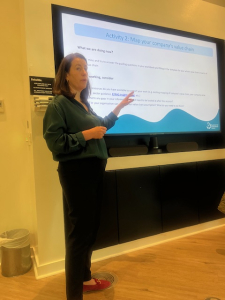
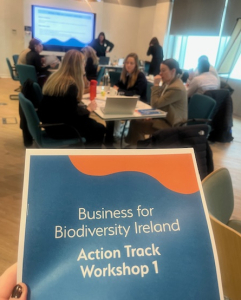
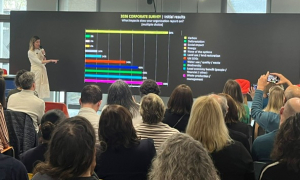
We launched into the second quarter of 2026 with a week of inspiring events that really brought home how much nature is now firmly on the business agenda alongside climate – kicking off on Tuesday, April 14th with our first in-person workshop of 2026 with this year’s first cohort of businesses for our Nature Strategy Accelerator Programme’s Action Track Workshop #1, delivered in association with Deloitte’s WorldClimate Team at their HQ in Dublin.

The focus: getting practical and helping our member organisations identify what’s truly material for them when it comes to reporting and strategy. More on that in future, with two more workshops in the pipeline. Huge thanks to all who participated in an interactive day-long session, to the BFBI team and our new Business Programme Lead Caroline Cawley making her workshop lead debut, to our Business Programme Advisor Dr Catherine Farrell for her continued input into the 2026 programme and to our workshop delivery partners Deloitte Ireland’s Sustainability Leader Caítlín Flanagan for their ongoing support.

That same day, the first Carbon & Nature Forum at Trinity Business School, hosted by the fantastic BE IMPACTFUL team, brought together a powerhouse line-up, with Asst Prof of Business & Nature Dr Catherine Farrell joining the panel discussions. Huge thanks to Tom Popple, Orlaith Delargy, and Louise French for creating such a valuable space. It was one of those sessions you don’t want to leave (even when your calendar says otherwise). Looking forward to being part of what comes next.

The evening of nature and climate conversations continued at the Climate Heist in The Sugar Club with Climate Cocktail Club – an engaging and thought-provoking mix of music and conversation, featuring voices such as Lesley O’Connor and Aoife O’Leary, alongside inspiring examples of climate innovation and entrepreneurship. BFBI is delighted to get involved in the Climate Cocktail Club’s second annual Climate Carnival ‘From Siloes to Systems’ coming up in September so stay tuned and join the mailing list for more updates on registration and collaboration opportunities. See www.climatecocktailclub.org/events

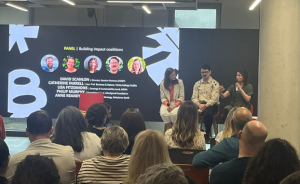
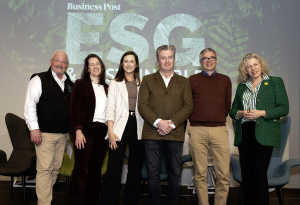
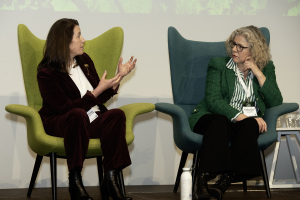
Wednesday took us to the Business Post ESG and Sustainable Business Summit in Croke Park, moderated by broadcaster Philip Boucher-Hayes, where BFBI was proud to take the stage on the dedicated Nature Panel, with Caroline Cawley joining Bob Hamilton, CEO of Irish Trees Ltd, (valued members of our Nature Strategy Accelerator Programme), Dr Siobhan McQuaid of GoNaturePositive!, Horizon Nua, Trinity College Dublin and Stewart Gee, of Climate KIC, and keynote speaker Anne Reaney of Rebalance Earth, sharing insights on how businesses are moving to a nature-positive way of working. Our team, including Research & Tech Lead Dr Emer Ní Dhúill and myself were on hand to chat to delegates at our BFBI exhibition stand. Another day of great discussions, strong engagement, and plenty of follow-ups already in motion.

We wrapped up the week on Thursday, April 16th, as finalists at the ESG Business & Finance Awards 2026 in the Biodiversity Leadership in Business category for the second year in a row. While it wasn’t our day, congratulations to Coillte on a well-deserved win. And a big thank you to Chartered Accountants Ireland and our Chair Susan Rossney for the warm hospitality and great conversations.


Also a big thankyou to our funders National Parks & Wildlife Service and to our associates in KPMG Ireland Sustainable Futures, the National Biodiversity Data Centre, Business in the Community Ireland, Natural Capital Ireland and SustainabilityExamples.com – and to everyone who has been involved in supporting our work helping Irish businesses to integrate biodiversity into business strategy to date.

It’s weeks like this that act as a reminder of just how much momentum is building around bringing nature into the boardroom. So many brilliant people, conversations and ideas – all contributing to what can sometimes feel like an uphill climb but one that’s absolutely worth it.

A strong reminder that progress happens through collaboration, persistence and showing up – again and again.

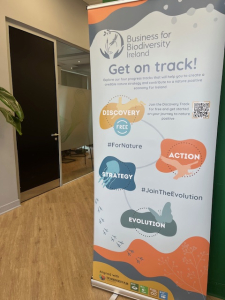
Ready to show up for nature? Sign up free today to our Nature Strategy Accelerator Programme Discovery Track to access free resources & webinars and take our 10-step module to build your biodiversity knowledge – https://businessforbiodiversity.ie/how-it-all-works/

ESG Summit photos by Maura Hickey

The European Commission has adopted targeted “quick fix” amendments to the first set of European Sustainability Reporting Standards (ESRS). This is aimed at reducing the burden and increasing certainty for companies that had to start reporting for financial year 2024 (commonly referred to as “wave one” companies).

According to the current ESRS, companies reporting on financial year 2024 can omit information on, amongst other things, the anticipated financial effects of certain sustainability‑related risks. The “quick fix” amendment, which applies from financial year 2025, will allow them to omit that same information for financial years 2025 and 2026.

For financial years 2025 and 2026, wave one companies with more than 750 employees will benefit from most of the same phase-in provisions that currently apply to companies with up to 750 employees. A summary of the modifications can be found here.

Wave one companies were not captured by the “stop‑the‑clock” Directive, which delayed sustainability reporting requirements for companies that report from financial year 2025 and 2026 (so‑called “wave two” and “wave three” companies) by two years. This Directive was part of the Omnibus I package adopted by the Commission in February 2025.

The Commission is working on a broader revision of the ESRS, with the aim of substantially reducing the number of data requirements, clarifying provisions deemed unclear and improving consistency with other pieces of legislation. It is expected that this review will be completed by financial year 2027.

Despite the ongoing delays and simplifications at EU level, assessing and reporting on your organisation’s nature impacts is still a vital and urgent part of any organisation’s long-term strategy – ignoring your dependencies and impacts on nature means ignoring the potential risks, both financial and reputational, to your business as well as the physical risks that damaging and degrading nature does to our planet, society and to your business’s resilience and longevity.

You can be a leader in your field by tackling these issues now – we’ll show you where to start. Sign up to our Nature Strategy Accelerator Programme today – join the Discovery Track for free to learn more – or contact our Business Development Manager Dr Maria Fitzpatrick for a chat on how to get started on a solid Nature Strategy for your organisation. We will be accepting new businesses to our Action and Strategy Tracks now ahead of our 2026 programme of workshops, peer learning and expert one-on-one guidance – email manager@businessforbiodiversity.ie

We are thrilled to announce the opening of memberships for our 2026 Action and Strategy Accelerator Tracks!

Starting in the summer of 2025, we will welcome new members to these cohorts of Irish businesses who are advancing along our Nature Strategy Accelerator Programme – providing a unique opportunity to evaluate your organisation’s readiness for a Double Materiality Assessment (on the Action Track) or to level up to craft a comprehensive Nature Strategy (Strategy Track).

New members will engage in a personalised assessment meeting with the BFBI team, receiving tailored guidance to bridge knowledge gaps and initiate impactful actions within your business.

In 2026, each track will feature three immersive full-day workshops, in collaboration with Deloitte‘s WorldClimate (Action) & KPMG Sustainable Futures (Strategy) Teams, and further personalised one-on-one calls as needed. Together, we’ll tackle key milestones, allowing each business to progress at a pace that aligns with their unique capacity and timelines.

BFBI is supported by National Parks & Wildlife Services. Find out more about the various Nature Strategy Accelerator tracks on our How It All Works page and get in touch with our Business Development Manager Dr Maria Fitzpatrick to discuss the options for your business, including grants aligned with our fees – email today manager@businessforbiodiversity.ie

BFBI Business Programme Lead Dr Catherine Farrell CIEEM, Trinity College Dublin, writes on the process steps around undertaking a Double Materiality Assessment (DMA) to help guide your nature strategy: this article focuses on the ways to understand how businesses interface with nature, highlighting the data needs but also the language of a DMA.

Following from our inspiring and interactive workshop on March 10th (read about it here), alongside colleagues from Deloitte, the Business for Biodiversity Ireland team led the second of our Action Track workshop series on May 20th. While our initial workshop focused on the key elements of what a Double Materiality Assessment (DMA) is (and/or isn’t), especially the value chain, this time we focused on how we can map and track the interface of business with nature.

This involves homing in on ‘the where’ part of the DMA process. In essence, this means gathering your organisation’s location data like maps, and – in tandem – figuring out the other types of data available, what they measure and why. Then its time to focus on how we might use data (which may be freely available as well as company-held) to inform our DMA. Our colleagues from Deloitte shared their DMA journey, highlighting how tools like the TNFD LEAP (Locate, Evaluate, Assess and Prepare), can help bring understanding of our business interfaces with nature to light.

In this article we focus more on data and the language of data and DMA (beware of the acronyms!):

Data: we hear a lot about data these days, but when we’re trying to understand our business impacts and dependencies (how we rely on nature) we really need to focus on data relating to aspects of nature referenced in the nature-related reporting frameworks like CSRD, TNFD, SBTN and GRI.

We can start by breaking these into –

  • Locational data (a map of where we operate – note, start with one part of your value chain and get the hang of it!)
  • What types of habitats or ecosystems are present in those places (the basic type and their extent)
  • What our impact is on these specific areas of ecosystem (how we influence their condition), and
  • How we rely on them (what we need from these ecosystems as inputs, aka ecosystem services to our operations) or impact them.

This helps us Locate, Evaluate and Assess our impacts, dependencies, risks and opportunities, and then Prepare to report (think LEAP). We can do this by using available data on habitats, but -now, a health warning – in Ireland habitat data is quite limited. With some ecological input to help, however, we can gather up what is available, in a useful way.

Language: ecological and nature lingo is nuanced but not beyond our reach. It’s helpful to have someone working with us that can communicate these nuances in a clear, simple way. During our workshop we discovered that acronyms and strange ‘eco’ languages can be off putting initially, but once we get into the flow, we find what we need to know.

Many thanks to Aoife Connaughton and Deloitte for collaborating on this workshop, National Biodiversity Data Centre’s Sarah Kelly, and all our Action Track businesses for participating in our Nature Strategy Accelerator Programme, including CIE and CIE Tours, Cloud Assist, Irish Rail, Irish Trees, Future Energy Ireland, KMK, Scott Cawley Ltd, Shannon Airport, Trinity College Dublin and Watermark Coffee.