
Tag Archive for: Deloitte

BFBI Business Programme Lead Dr Catherine Farrell CIEEM, Assistant Professor in Business and Nature at Trinity College Dublin, writes on emerging nature-related disclosure requirements and how stakeholder engagement is a key process step in building collective understanding for business and nature, as workshopped with businesses in our Nature Strategy Accelerator Programme, delivered in collaboration with the Deloitte WorldClimate team.

“It was a beautiful autumn day when our group met in the Deloitte offices in Dublin’s city centre for the last of our three Action Track workshops that focused on the assess phase of the ACT-D framework. In our first workshop, our keen focus was on building an understanding of our value chain – what we do, where – and how that impacts on nature and, importantly, how much we depend on nature.

Too often businesses are experiencing chinks in the flow of essential components of their supply chains due to a fault in a lengthy global chain, with many of those faults related to climate and biodiversity related risks. If we understand these aspects, we can begin to address ways (opportunities) to mitigate those risks.

The next step is to take a metaphorical LEAP (literally: Locate, Evaluate and Assess our impacts, dependencies, risks and opportunities, and then Prepare to report) and draw a map whereby we can begin a deeper dive and evaluate and assess those dependencies, risks and impacts.

But as we draw that map, we must take time to draw out what stakeholders matter, where, and why. Thanks to the Deloitte team for outlining key stages in a stakeholder engagement and communications plan. Stakeholder engagement isn’t just an option – it’s fundamental to being part of a global community, expressed through global and local links in our value chain.
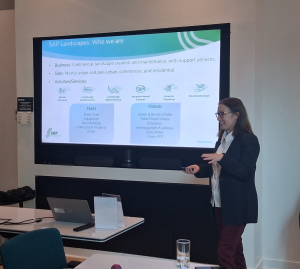
Woman speaks at large screenshowing text in blue boxes and small icons

Under the Corporate Sustainability Reporting Directive (CSRD), Taskforce on Nature-related Financial Disclosure (TNFD) and other guidance such as the Global Reporting Initiative (GRI) and ACT-D, (Assess/Commit/Transform/Disclose), stakeholder engagement is essential for a thorough Double Materiality Assessment process, and critical to any business’ local and global reputation. We were fortunate to have Janice Leonard of SAP Landscapes, above, a business in the next track up, Strategy, present her own journey through DMA and stakeholder engagement, bringing a real-world / learning-by-doing perspective. The SAP Landscapes journey is inspiring, and we all benefited from Janice’s insights, which included the need for steady dedication and the benefits of drawing on the Business for Biodiversity Ireland community within the Nature Strategy Accelerator Programme.

While there is a steep learning curve for many businesses in building awareness and understanding in relation to biodiversity and ecosystems, and the role business is poised to play in driving Nature Positive ambition, Business for Biodiversity Ireland is a reliable support to help businesses of every size and sector work through inter-connections and complexities.

Thanks to all our Action Track businesses for their generosity in sharing their own journeys and we look forward to working with you on the Strategic next phase. Thanks to SAP Landscapes, CIÉ, CIÉ Tours, Cloud Assist, Dublin Airport Authority, FuturEnergy Ireland, Irish Rail, Irish Trees, Scott Cawley Ltd, Shannon Airport, Trinity College Dublin and Watermark.

We are thrilled to announce the opening of memberships for our 2026 Action and Strategy Accelerator Tracks!

Starting in the summer of 2025, we will welcome new members to these cohorts of Irish businesses who are advancing along our Nature Strategy Accelerator Programme – providing a unique opportunity to evaluate your organisation’s readiness for a Double Materiality Assessment (on the Action Track) or to level up to craft a comprehensive Nature Strategy (Strategy Track).

New members will engage in a personalised assessment meeting with the BFBI team, receiving tailored guidance to bridge knowledge gaps and initiate impactful actions within your business.

In 2026, each track will feature three immersive full-day workshops, in collaboration with Deloitte‘s WorldClimate (Action) & KPMG Sustainable Futures (Strategy) Teams, and further personalised one-on-one calls as needed. Together, we’ll tackle key milestones, allowing each business to progress at a pace that aligns with their unique capacity and timelines.

BFBI is supported by National Parks & Wildlife Services. Find out more about the various Nature Strategy Accelerator tracks on our How It All Works page and get in touch with our Business Development Manager Dr Maria Fitzpatrick to discuss the options for your business, including grants aligned with our fees – email today manager@businessforbiodiversity.ie

BFBI Business Programme Lead Dr Catherine Farrell CIEEM, Trinity College Dublin, writes on the process steps around undertaking a Double Materiality Assessment (DMA) to help guide your nature strategy: this article focuses on the ways to understand how businesses interface with nature, highlighting the data needs but also the language of a DMA.

Following from our inspiring and interactive workshop on March 10th (read about it here), alongside colleagues from Deloitte, the Business for Biodiversity Ireland team led the second of our Action Track workshop series on May 20th. While our initial workshop focused on the key elements of what a Double Materiality Assessment (DMA) is (and/or isn’t), especially the value chain, this time we focused on how we can map and track the interface of business with nature.

This involves homing in on ‘the where’ part of the DMA process. In essence, this means gathering your organisation’s location data like maps, and – in tandem – figuring out the other types of data available, what they measure and why. Then its time to focus on how we might use data (which may be freely available as well as company-held) to inform our DMA. Our colleagues from Deloitte shared their DMA journey, highlighting how tools like the TNFD LEAP (Locate, Evaluate, Assess and Prepare), can help bring understanding of our business interfaces with nature to light.

In this article we focus more on data and the language of data and DMA (beware of the acronyms!):

Data: we hear a lot about data these days, but when we’re trying to understand our business impacts and dependencies (how we rely on nature) we really need to focus on data relating to aspects of nature referenced in the nature-related reporting frameworks like CSRD, TNFD, SBTN and GRI.

We can start by breaking these into –

  • Locational data (a map of where we operate – note, start with one part of your value chain and get the hang of it!)
  • What types of habitats or ecosystems are present in those places (the basic type and their extent)
  • What our impact is on these specific areas of ecosystem (how we influence their condition), and
  • How we rely on them (what we need from these ecosystems as inputs, aka ecosystem services to our operations) or impact them.

This helps us Locate, Evaluate and Assess our impacts, dependencies, risks and opportunities, and then Prepare to report (think LEAP). We can do this by using available data on habitats, but -now, a health warning – in Ireland habitat data is quite limited. With some ecological input to help, however, we can gather up what is available, in a useful way.

Language: ecological and nature lingo is nuanced but not beyond our reach. It’s helpful to have someone working with us that can communicate these nuances in a clear, simple way. During our workshop we discovered that acronyms and strange ‘eco’ languages can be off putting initially, but once we get into the flow, we find what we need to know.

Many thanks to Aoife Connaughton and Deloitte for collaborating on this workshop, National Biodiversity Data Centre’s Sarah Kelly, and all our Action Track businesses for participating in our Nature Strategy Accelerator Programme, including CIE and CIE Tours, Cloud Assist, Irish Rail, Irish Trees, Future Energy Ireland, KMK, Scott Cawley Ltd, Shannon Airport, Trinity College Dublin and Watermark Coffee.

Tag Archive for: Deloitte