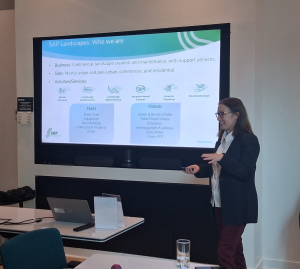
Business for Biodiversity Ireland is delighted to announce the newest member of our team, Dr Maria Fitzpatrick, who has taken on the role of Business Development Manager, working with Irish businesses to ensure they get the most from their membership of BFBI.

Biodiversity & Sustainability Consultant Maria has a PhD in Freshwater Ecology and worked as an Environmental Consultant before moving to Queen Mary University of London and then on to the Royal Botanic Gardens, Kew to build and head the Research Funding Services for Kew Science.

She is Circular Economy-trained with a Corporate Sustainability Reporting Directive professional qualification. Her background blends scientific expertise with project and relationship management skills, and a keen understanding of the environmental challenges our world is facing to build compelling cases for change. Maria also sits on the steering committee for Natural Capital Ireland.

Maria shared:

“I am excited to be working with the brilliant team at Business For Biodiversity Ireland to help shape and drive forward our 2025 business development strategy. This will be working to bring businesses on board with our Nature Strategy Accelerator Programme, supporting businesses in the transition to achieving a thriving nature-positive economy here in Ireland and beyond.”

You can contact Maria with queries at manager@businessforbiodiversity.ie

Minister of State for Nature, Heritage and Biodiversity, Christopher O’Sullivan TD, has launched the Biodiversity Duty Reporting Guidance for Public Bodies, developed by the National Parks and Wildlife Service with support from Business for Biodiversity Ireland.

The guidance provides practical steps to help public bodies fulfil their ‘biodiversity duty’ – a new legal requirement for public and state bodies to consider biodiversity in their decision making and daily operations.  The guidance will also assist public bodies in fulfilling their biodiversity reporting obligations.

Launching the guidance documents to be issued to all listed public bodies, Minister O’Sullivan, pictured right, above with the BFBI team, said: “All of us have a role to play in protecting our biodiversity, and that includes our public and state bodies. Many of them, including ESB and Iarnród Éireann, are already leading by example and can see the benefits – for biodiversity, for the public and their own organisations.

“This guidance will help even more of our public bodies to make a commitment to biodiversity. It suggests areas of business activities within public bodies, from procurement, to construction, landscape management and organisational development, which can have a real impact on our biodiversity. It will also support public and state bodies to report on their progress over the coming months as required by the legislation.”

Biodiversity Duty Reporting Guidance for Public Bodies provides actionable steps and tools for public bodies to embed biodiversity considerations into their operations. It indicates areas of opportunity within public bodies where biodiversity can be incorporated, and sets out how biodiversity duty can be strengthened through clear targets, knowledge and skills development, collaboration and implementation.

The ESB is a member of the Business for Biodiversity Ireland platform, and has been working to develop a Nature Strategy in response to the recognised growing need for business guidance in transitioning to a nature-positive way of working.

Geoff Hamilton, Biodiversity Lead at ESB, pictured left, above, said: “Biodiversity action is a core part of ESB’s ambition to make a difference for planet, place and people; we aim to be nature-positive by 2030. In 2024, ESB appointed a Group Head of Sustainability, who has completed the establishment of a new Centre of Sustainability – including the creation of a new role of Group Biodiversity Lead, tasked with driving biodiversity action and transformation across ESB’s business units.

“We have recently published the ESB Networks Biodiversity Strategy ‘Networks for Nature’ and are currently in the process of developing similar strategies for other constituent business units of ESB. ESB wholeheartedly welcomes this new guidance document, which provides clear directions with regard to our annual reporting duty.”

Read more on the government website HERE and access the guidance document HERE.


Pictured, L-R: Geoff Hamilton, Biodiversity Lead, ESB; Fiona Smith, Communications, BFBI; Dr Emer Ní Dhúill, Research at BFBI; Iseult Sheehy, Operations, BFBI; Sinead Kilkelly, Executive Director, People & Sustainability, ESB; Dr Maria FitzPatrick, BFBI Business Development Manager; and Minister for Nature Christopher O’Sullivan TD.

Business For Biodiversity Ireland is delighted to be named as a finalist in the Business & Finance Media Group ESG Awards 2025 – in association with Grant Thornton Ireland – in the ‘Biodiversity Leadership in Business Award’ category.

The awards recognise the efforts of companies in Environmental, Social, and Governance (ESG) practices, and celebrate those driving change through innovative policies, technology solutions, and sustainable business practices.

Congratulations also to our fellow nominees Wildacres, Biodiversity In Schools, Coillte and Dublin Port Company and to all the nominees across categories including An Post, Dublin Port Company, Bord Gáis Energy and Aldi.

The ESG Leader Award will be presented to Mary Robinson, recognising her dedication to sustainability, climate justice, and social equity on both a national and global scale.

Tracey Carney, Managing Director, Business & Finance, said: “The calibre of entries for the 2025 Business & Finance ESG Awards reflects the remarkable strides taken by organisations across Ireland in integrating sustainability at the core of their business strategies.

“We are seeing a significant shift towards collective responsibility, where entire teams are driving change and delivering measurable ESG impact.”

The winners will be announced in a ceremony on April 10 in The Mansion House, Dublin.

Read more on the Business & Finance site.
Read more on RTE News.

Business For Biodiversity Ireland is delighted to announce that Dr Catherine Farrell is moving over from our Board of Directors to take on the role of Business Programme Lead.

A pioneer of ecological restoration and research in Ireland and internationally, having developed Ireland’s first Biodiversity Action Plan for a corporate body (Bord na Móna), Catherine is a Senior Research Fellow in the School of Natural Sciences and Adjunct Teaching Fellow in Trinity Business School at Trinity College Dublin.

Catherine developed a new TCD module for 2024-2025, The Business of Nature Positive, which incorporates learnings about nature, society and economy, exploring ways for undergraduate students to work with businesses in Ireland to support the global Nature Positive Initiative, and report through the Corporate Sustainability Reporting Directive.

Catherine worked on the EPA-funded research project INCASE, applying the UN SEEA Ecosystem Accounting framework at catchment scale in Ireland up to 2022, and her current research as part of BiOrbic National Bioeconomy Research Centre focuses on developing mechanisms to structure, finance, monitor and communicate the direct impacts and broader societal benefits of nature restoration (Project ReFarm).  She was lead organiser of the Peatlands Gathering 2021, and is also a member of the ongoing National Land Use Review process.

Read more on our Meet the Team page.


2024 was an eventful year for those of us working in advancing nature action at both national and global level.

The much-contested  EU Nature Restoration Law  was brought in – and the Green Party, which was in Government at the time, with Ireland’s first Minister for Nature Malcolm Noonan, were instrumental in getting it over the line. However, there remains political pushback at home and abroad as we enter 2025 and environmental concerns slip further down the agenda in the face of the cost-of-living crisis, political turmoil and global conflict. 

Extreme weather incidents are putting these concerns squarely back on the agenda for the private sector as we start 2025, particularly in the area of insurance and financial investments. Fears are being raised in the food sector due to the climate and nature crises, and we will likely see tourism, hospitality and retail affected globally, as well as a rise in public health concerns. The latest  WEF Global Risks Report  rates several environment-related risks in prominent positions in their Top 10 for a 10-year analysis, with the risk from biodiversity loss and ecosystem collapse ranked in second place, after extreme weather events. The short-term (2 years) risk analysis ranks extreme weather events in second place, however, the risk from biodiversity loss and ecosystem collapse is not as prominent yet on the short-term list of worries for polled business leaders. This is surprising given that it is now widely understood that biodiverse ecosystems create resilient landscapes and enhance carbon sequestration, lessening the effects of climate change such as extreme weather events. (The Economics of Biodiversity aka the Dasgupta Review, for the UK Treasury in 2021, warns we must start accounting for nature’s contributions in national accounts to inform decision-making for future resilience).

We welcome the announcement of a new Minister of State for Nature, Heritage & Biodiversity, Christopher O’Sullivan TD, at the Department of Housing, Local Government and Heritage, and hope concrete and swift action on nature loss and degradation will be set in motion once Ireland’s National Restoration Plan, being developed by the  National Parks & Wildlife Service  in conjunction with relevant stakeholders, is finalised. The new  Programme for Government  pledges to keep the Infrastructure, Nature & Climate Fund, instigated by the previous government, with plans to pursue more funding at EU level, and delivery of Ireland’s  National Biodiversity Action Plan 2023-2030,  which sees a whole-of-government, whole-of-society approach. We look forward to continuing to work with a number of government departments in developing and implementing actions to support businesses in achieving this. 

Despite an uneven progress following successive global summits on climate and nature, BFBI agrees with recent commentary by Business for Nature’s CEO Eva Zabey that interest levels and discussions on biodiversity within the business and policy world are certainly “maturing and multiplying”. “Tackling complex issues such as biodiversity loss and its interconnections with climate and social equity takes time, where global discussions remain key, even if they don’t always result in the urgent progress we are collectively striving for.

“This requires all of us to act with both urgency and perseverance. We take heart in the progress made over the past 12 months by our fantastic community and partners, and by the growing number of businesses and policymakers committed to building a nature-positive future for all by 2030.”

Zabey lists some key highlights from the past year, including the introduction of the EU’s Corporate Sustainability Reporting Directive (CSRD) in effect for 11,000 companies in 2025.

Over 500 companies have committed to disclosing their nature-related issues to investors using the TNFD recommendations – a 57% increase since the beginning of the year, 30 companies have published dedicated nature strategies through It’s Now for Nature and first mover companies publicly adopted science-based targets for nature. These are encouraging signals of change.”

However voluntary action by businesses is far from the norm, and many organisations still do not understand their impacts and dependencies on nature. There is confusion among Irish companies on the scope of the new reporting rules, with a number of our larger legal firms seeking clarification from the Government on how the legislation is to be applied in Ireland.

It is essential that the new Government and the business sector show leadership in making this the year to accelerate our transition to Nature Positive rather than risk playing catch-up – if you are new to it all, start here on our free Discovery Track with access to the evolving guidance and resources coming your way in 2025, including our free webinar series.

Those keen to make the commitment to put prior learning and resources into action now can join our Nature Strategy Accelerator Programme’s paid Action Track for tailored help to get your reporting on track, and be ready to make real positive impact for your business and for nature. We’ll help you to advance to our Strategy Track and Evolution Track, through our Roadmap to Nature Positive (in alignment with the global Now for Nature Strategy), to maintain a steady path to long-term sustainability.

Get on track HERE.


Business For Biodiversity Ireland is delighted to announce the appointment of a new Board of Directors to guide and inform our work to ensure Irish businesses are ready to join the global push for a transition to a nature-positive economy.

With a climate and biodiversity emergency declared by the Government in 2019, the BFBI platform was seed-funded by the Department of Agriculture and the Department of Housing, Local Government and Heritage in 2021, in recognition of the urgent need for Irish businesses to address their impacts and dependencies on nature. The platform has now developed the Nature Strategy Accelerator Programme to get businesses on track to a nature-positive way of working with up to date guidance on emerging sustainability frameworks and comply with EU directives on environmental reporting.

New Board Chair Susan Rossney, Sustainability Advocacy Manager with the Institute of Chartered Accountants Ireland, said: “A nature-positive economy is vital to our long-term economic resilience – 55% of the world’s GDP is moderately or highly dependent on nature. Despite this, many businesses are unaware of their dependence on and impact on biodiversity, a risk made all the greater now that larger companies are legally bound to disclose information on their environmental impact via the Corporate Sustainability Reporting Directive or CSRD.”

The BFBI Board of Directors also includes:

– Secretary Lisa Davidson, experienced finance and banking professional

– Vice President for Biodiversity and Climate Action and ecology professor at Trinity College Dublin, Jane Stout

– Dr Catherine Farrell, former Bord na Mona ecologist, now Trinity Professor and pioneer of innovative environmental projects including ReFarm and Natural Capital Ireland

– Ken Whitelaw, Sustainability Manager of IDA Ireland

– Asst Prof Kirstie McAdoo of University College Dublin, formerly Airfield Estate

– world-leading biodiversity consultant Edward Pollard, director of the UK Business and Biodiversity Forum, a specialist in demystifying nature for business.

Welcoming the new Board, Executive Director Lucy Gaffney said: “We are thrilled to have such an accomplished team of experts with a wealth of knowledge and experience in business, sustainability and nature restoration.”

Meet the Business For Biodiversity Ireland Board HERE.

Business For Biodiversity Ireland (BFBI) has released our Nature Strategy Accelerator Programme to guide Irish businesses to develop a strong, credible strategy to identify their impacts and dependencies on nature and ensure compliance with the new EU legislation regarding environmental reporting.  

The Nature Strategy Accelerator Programme has been developed following a series of insightful sessions with the European Business and Biodiversity Platform and other national platforms, and reflects a model of best practice in line with current international developments, tailored to the Irish context and aligned with grants available in Ireland through Local Enterprise Offices, Enterprise Ireland, Údarás or the IDA.

All new and existing Business For Biodiversity Ireland members can avail of the introductory Discovery Track for free, with access to guidance and webinars to bring them up to speed on their relationship to biodiversity.

The Discovery Track offers:

  • Three biodiversity-focused training webinars throughout the year
  • Guidance on how to start your nature-positive journey
  • Curated videos and online training resources to help you on your way
  • A quarterly newsletter with details of upcoming biodiversity-focused events
  • Updates on EU regulations such as the Corporate Sustainability Reporting Directive (CSRD).

BFBI Chair of the Board Susan Rossney, Sustainability Advocacy Manager of Chartered Accountants Ireland, urged all businesses to join up and start their journey, as time is of the essence to ensure a sustainable ‘Nature Positive’ future for the Irish economy. She said: “A whole-of-society approach is needed to deliver a nature-positive economy – an economy that results in increasing levels of nature over time and that no longer incentivises the overexploitation of nature. Nature provides a third of the climate mitigation potential we need to achieve our climate goals, so delivering a nature-positive economy is imperative for reaching our climate targets.

“A nature-positive economy is similarly vital to our long-term economic resilience: 55% of the world’s GDP is moderately or highly dependent on nature. Despite this, many businesses are unaware of their dependence on and impact on biodiversity, a risk made all the greater now that larger companies are legally bound to disclose information on their environmental impact via the CSRD.

“As the pivotal UN Biodiversity Conference ‘COP16’ takes place to address the global biodiversity crisis, and as the World Wildlife Foundation’s Living Planet Report tells us of 73% average decline in wildlife populations over the last 50 years, it is a fitting time for Business for Biodiversity Ireland to launch our Nature Strategy Accelerator Programme. With a mandate under the 4th National Biodiversity Action Plan, BFBI has built a powerful profile advocating for nature-positive business. This programme will empower businesses to deliver positive outcomes for people, planet and nature.”

Explore the benefits of our Discovery Track: How it all works 

All members are invited to join the Discovery Track series of webinars.

Register now to join the next webinar on March 26, 2025, 9.30.

With only a quarter of our wild species remaining on the planet, we need to act now to protect what’s left, writes BFBI Executive Director Lucy Gaffney. 

As COP29 in Baku, Azerbaijan draws ever closer, the alignment of biodiversity and climate is emerging as a key theme, with nature featuring specifically on day 10 (21st of November), the penultimate day.

The latest WWF Living Planet Report reveals some grim statistics about the current state of nature globally. We are now showing a decline of 73%, a drop of almost three quarters, in the average size of our monitored wildlife populations, with over a million plant and animal species at risk of extinction. Humans have already altered three quarters of our planet’s land surface and two thirds of our marine environments. Although changes in the environment may appear gradual and relatively small, we are beginning to see evidence of their cumulative effects and there are concerns that we are approaching dangerous, irreversible tipping points. If we tip over, the results may be catastrophic. 

Tipping points 

When our planetary systems surpass a tipping point, the results can be unpredictable, and potentially devastating. Nature is approaching these tipping points much faster than predicted. Perhaps we’ll see the collapse of local fish stocks, impacting the livelihoods of the local community. Maybe we will bear witness to regional fish stock collapse on a larger scale that may have a much larger impact on the global economy, destabilising supply chains and income streams on a much grander scale. This is not just an environmental issue, it will affect everyone, everywhere. 

What systems are close to breaking point?  

The Amazon Rainforest supports more than 10% of the planet’s biodiversity and 10% of all known fish species. More than 47 million people call it home. In terms of carbon storage, it sequesters between 250 and 300 billion tonnes of carbon. But decades of deforestation and degradation driven by the beef, soy and palm industries have compromised the Amazon’s resilience. There are fewer trees, leading to less rainfall and increased drought risk. With increasing global temperatures, the Amazon is getting hotter and drier. This means that it is vulnerable to wildfires and is at an increased risk of entering into a vicious cycle of heating and burning. We will feel the impact of this on a global scale with decreased rainfall in water-stressed areas, reduced agricultural productivity and increased food and water scarcity. 

If the Amazon reaches this tipping point it would flip from being a climate ally and would start accelerating climate change. It is estimated that the destruction of Amazonian plants and trees will release 75 billion tonnes of carbon into the atmosphere. So how close are we to tipping the scales? This WWF report predicts that if we remove 20-25% of the Amazon Rainforest, the system will tip. We’re at 17%. 

This is just one critical tipping point. We are also dangerously close to 4 other tipping points, each of which has the potential to push other planetary systems closer to the edge, threatening our earth’s life support systems and society as we know it. 

Melting Ice Sheets in Greenland and the Antarctic have the potential to significantly alter oceanic circulation systems and cause sea levels to rise by several metres. 

Dying Coral Reefs could destroy fishing zones, impacting hundreds of millions of people who depend on the reefs for sustenance. Coral reefs also offer flood and storm protection for these local communities. 

Changing Ocean Currents will devastate marine ecosystems and alter global weather patterns resulting in more extreme winters and more intense summer heatwaves, particularly in Europe. 

Melting Permafrost releases greenhouse gases and other contaminants into the ocean. 

We know what we need to do! 

Nature is remarkably resilient, and if afforded the chance, it will recover. We know what we need to do to alter this disastrous trajectory. Restore ecosystems and increase their resilience. We need to transform our food and energy systems, the main drivers of biodiversity loss and climate change. We need to move money away from damaging activities and fossil fuel investments, and towards nature restoration and protection. 

Ecological breakdown is happening as a result of unrestricted, uncontrolled economic endeavours and business and industry have a critical role to play in turning the tide. Target 15 of the Global Biodiversity Framework asks that businesses assess and disclose their impacts on nature, with a view to creating and implementing a nature strategy that will limit the damage they are doing. The goal is to shift business models into a nature-positive mode, where activities no longer harm the natural world and resources are deployed towards the protection and conservation of what we have left, that 27%. The Global Goal for Nature calls for a halting and reversing of nature loss by 2030, and a trajectory of recovery from then on. 

The world is waking up and we now recognise the need for change. There’s no shortage of knowledge, people or passion to achieve our objectives and turn things around. What we need now is urgent action. Governments, businesses and communities need to mobilise to ensure that we have a healthy planet to pass on to future generations. Individual behaviours matter, mindset matters. Society has the power to change both. With our collective efforts, nature can bounce back.   

Lucy Gaffney is Executive Director of Business for Biodiversity Ireland – join today and we can help your business understand your impacts and dependencies on nature and create a strong nature strategy.  


Companies are taking a variety of approaches to conducting materiality assessments for their annual reporting in terms of biodiversity and other #ESG topics – but how to be sure your approach is on the right track?

As we compare and contrast assessment approaches in the course of our research, we have noticed that some reports come across as somewhat lacking in focus and substance, while stakeholder engagement appears to vary from cursory at best, brief surveys targeted at a small cohort, to in-depth discussions over a large cross-section of interested groups and individuals. Some reports seem weighted toward the concerns of shareholders rather than matters that impact society at large, while some obfuscate negative environmental and social impacts via their report’s presentation style, veering dangerously close to greenwashing.  

Fortunately, a number of methods and frameworks have emerged to facilitate Environmental, Social and Governance reporting and, in terms of standardisation, the Global Reporting Initiative (GRI) framework provides a solid, comprehensive approach for businesses reporting on their ESG performance. 

The European Union’s Corporate Sustainability Reporting Directive (CSRD) requires the use of double materiality in sustainability disclosures, which acknowledges that materiality – what matters most to a business – can no longer be viewed from a purely financial perspective. Traditionally, a material issue is one that could significantly influence the financial decisions of investors. However, this approach has expanded in recent years, as stakeholders, including regulators and consumers, have increasingly called for businesses to consider their broader societal and environmental impacts. 

A double materiality assessment takes into account two perspectives: 

  1. Financial Materiality: How ESG issues could impact a company’s financial performance. For example, stricter environmental regulations could lead to increased compliance costs, or climate-related risks could lead to asset devaluation. 
  1. Impact Materiality: The external impacts that a company’s operations, products, or services have on society and the environment. For instance, a company’s carbon emissions, deforestation, or supply chain labour practices might negatively affect local communities or contribute to global environmental challenges. 

Both aspects are interconnected and the double materiality approach offers a holistic understanding of a company’s risks and opportunities, enabling a businesses to better anticipate future trends, such as shifts in consumer preferences toward sustainable products or the financial implications of climate change, and nature degradation, as a result of business impacts. 

In particular, GRI 3: Material Topics provides guidance on how businesses can identify, assess, and prioritise material topics for reporting. The approach is quite stakeholder-focused and involves the following steps: 

Step 1: Understand the organisation’s context  

GRI 3 encourages businesses to think broadly about potential topics, not just those that have an immediate or obvious financial impact, but those that reflect significant external societal or environmental concerns. Consider: 

  • Business activities 
  • Business relationships 
  • Sustainability context 
  • Stakeholders 

Thorough and ongoing stakeholder engagement is key to identifying material topics, alongside a review of the latest industry standards, regulatory developments and examining reports by other organisations. Contact as many of your stakeholders as you can and examine their concerns – employees, customers, local communities, NGOs and regulatory bodies.  

For this exercise to be effective, you must engage at-risk or vulnerable groups and consider impacts that result in collective harm (e.g. GHG emissions), which require consultation with experts in this field. Identify the full range of ESG topics that could be relevant to the business – these go beyond climate change and biodiversity to labour and human rights, community relations and governance.  

Step 2: Identify actual and potential impacts 

Financial materiality: Evaluate how the issues raised by stakeholders might impact the company’s financial performance. Risks related to climate change, such as increased operational costs due to carbon pricing, or physical damage to assets from extreme weather events, could have material financial consequences for a business.  

Impact materiality: how do your company’s operations and activities affect society and the environment? For example, a company’s operations may generate waste or pollution, harming local ecosystems and communities. These impacts may not affect the company’s bottom line in the shortterm but are still relevant to stakeholders and fall under the company’s overall environmental and social responsibility. 

Where data is not immediately available or clear, conduct a scoping exercise to identify areas where negative impacts are likely to happen, considering impacts commonly associated with your sector. Identify also any positive impacts – those that contribute to nature restoration, conservation, protection or regeneration. 

Step 3: Assess the significance of the impacts 

The significance of the impact will be specific to each organisation and influenced by the sectors in which it operates. Consultation with experts is essential here. An actual negative impact’s significance is determined by its severity. Significance of a potential impact is determined by both the severity and likelihood of the impact, a.k.a. risk.  

Severity is determined by: 

  • Scale – how grave the impact is, including from a compliance perspective 
  • Scope – how widespread the impact is 
  • Irremediable character – how difficult it is to fix. 

For positive impacts, also look at scale and scope. How beneficial is the impact? How widespread is it or could it be?

Step 4: Prioritise Material Topics

After assessing both the financial and impact materiality, businesses must prioritise the topics that are most significant. This involves balancing the interests of shareholders (who may be primarily concerned with financial materiality) and stakeholders (who may be more concerned with societal and environmental impacts).

Step 5: Review and Disclose

The results of the double materiality assessment should be reviewed by the senior management before disclosure. Material topics should be shared in the company’s annual report. Under GRI standards, the company must explain how it conducted its materiality assessment and provide clear information on the financial and societal impacts of its operations as well as explaining why some standard topics are not considered material.

In each reporting period, review material topics from previous assessments and account for changes in the impacts, and changes due to organisational activities or business relationships. Document the approach taken for each assessment, including the methods of stakeholder engagement, evaluation, visualisation and reporting methods (and actions taken as a result). These elements should all be monitored, reviewed and updated regularly, as material issues can evolve over time. New regulations, shifting stakeholder expectations or emerging ESG risks will entail updating your materiality assessment considerations and methods in future. 

This idea is known as Dynamic Materiality​: “As companies more rapidly change their business models, what is material to such companies will be changing in stride. ​Just as the new material topics will emerge for companies as the company evolves, some sustainability issues that were previously material financially to companies will no longer be”. (​Kuh et al, 2020). 

By conducting a double materiality assessment now, on a voluntary basis, companies who do not yet fall under regulations can be ready for when regulation expands to encompass businesses of every scale and sector, and help secure a place in the supply and value chains of larger organisations who are currently mandated to report.

Transparent disclosure, as well as taking concrete action on biodiversity impacts and other ESG material topics, will enhance your business reputation with consumers and peers, while mitigating risks, boosting long-term resilience and contributing to a more sustainable future. 

The Business For Biodiversity Ireland platform offers guidance to all Irish businesses to build internal capacity to understand your material topics – sign up today.

Illustration: Figure 1(a), EFRAG IG1 Implementation Guidance on Double Materiality, May 2024. The European Sustainability Reporting Standards has published a materiality assessment document, P10 deals with double materiality, with a section on FAQs via the EFRAG site.

Visit the Global Reporting Initiative site for more information: https://www.globalreporting.org/how-to-use-the-gri-standards/gri-standards-english-language/ 


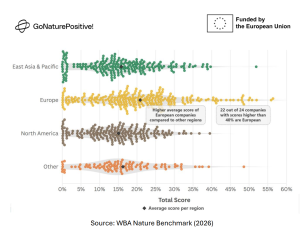
The World Benchmarking Alliance has released an updated Nature Benchmark, assessing how more than 800 major companies across varied sectors are impacting nature and protecting and restoring ecosystems.

Using company data and performance from 2022-2024, the research finds that, although some companies are helping to halt and reverse biodiversity loss, the majority do not yet fully understand how they impact and depend on nature. Only 5% of all companies have carried out an assessment of the impact of their operations on nature, and less than 1% have assessed their dependencies on nature.

The research, which explored the performance of companies such as Unilever, Kering and Nestlé, assessed companies across plastics, water stewardship, environmental rights, and board-level accountability, finding worrying gaps in key areas such as water use, ecosystem conversion and respecting local communities’ rights.

Two industries outperformed the rest in terms of ranking: Personal & Household Products, with an average score of 26 out of 100, and Pharmaceuticals & Biotechnology, with an average score of 20.

Nature blind spot: only 5% of companies assess their impact, and less than 1% understand dependencies

Only 5% of companies have carried out an assessment of the impact of their operations on nature. Less than 1% of companies have carried out an assessment of their dependencies on nature. This is worrying, as it means that companies cannot strategically manage and prioritise their actions on nature. Although some companies have started to assess their impacts and dependencies, they often only cover a fraction of their operations or don’t publish the results. They also tend to focus on land or freshwater, neglecting the marine realm. The landscape is rapidly changing – the EU Corporate Sustainability Reporting Directive, which has just come into effect, will require many large businesses to disclose their material sustainability impacts and dependencies from 2025 and will affect smaller companies down the line.

Regardless of their current regulatory requirements, all companies should begin applying a risk management and disclosure framework such as the Taskforce on Nature-Related Financial Disclosures.

You can view and filter companies involved by ranking and sector here: https://www.worldbenchmarkingalliance.org/publication/nature/rankings/

Companies overwhelmingly disregard Indigenous Peoples’ rights

Indigenous Peoples and local communities often live in critical ecosystems and coexist with threatened species. They manage about 40% of all terrestrial protected areas and their ecological knowledge enables a sustainable existence worldwide, yet less than 13% of companies assessed express a clear commitment to respect Indigenous Peoples’ rights.

As water insecurity rises, companies must accelerate their water stewardship

72% of the world’s population is water insecure. Findings show that 29% of companies are reporting water use reductions or disclosing water usage from water-stressed areas, suggesting a growing awareness of their role in ensuring water availability worldwide. However, water scarcity is also about the quality of available water for essential human needs like drinking and bathing. Only 15% of companies are reporting metrics on discharged pollutants, and just 4% have set targets to reduce them.

High risk of greenwashing on plastic, as companies struggle to back up efforts with data

Despite the comparatively high proportion of companies that provide qualitative evidence of working on plastic reduction (43%), their performance significantly drops regarding whether they are providing quantitative metrics (19%) to back these up, and even more so for whether they have a quantitative, time-bound targets (7%) to reduce plastic use and waste.

Increasing board accountability is vital: more leadership needed at the top

While 66% of companies assign sustainability oversight to their boards, only 2% of companies have boards that can demonstrate they have the relevant expertise on topics like biodiversity or climate. It is apparent that companies that demonstrate robust corporate governance score significantly better on other sustainability issues. To enable impact, companies should prioritise developing a sustainability strategy that covers nature, supported by concrete high-level responsibility and accountability for delivering the strategy.

Irish-based companies can start by joining Business For Biodiversity Ireland and getting started on our Roadmap to Nature Positive which will enable your organisation to build a strong biodiversity strategy.

You can visit a Nature Benchmark FAQ here to find out more.

Read the Nature Benchmark HERE.

Join the BFBI Nature Strategy Accelerator Programme HERE.