Tag Archive for: TNFD

BFBI Business Programme Lead Dr Catherine Farrell CIEEM, Assistant Professor in Business and Nature at Trinity College Dublin, writes on emerging nature-related disclosure requirements and how stakeholder engagement is a key process step in building collective understanding for business and nature, as workshopped with businesses in our Nature Strategy Accelerator Programme, delivered in collaboration with the Deloitte WorldClimate team.

“It was a beautiful autumn day when our group met in the Deloitte offices in Dublin’s city centre for the last of our three Action Track workshops that focused on the assess phase of the ACT-D framework. In our first workshop, our keen focus was on building an understanding of our value chain – what we do, where – and how that impacts on nature and, importantly, how much we depend on nature.

Too often businesses are experiencing chinks in the flow of essential components of their supply chains due to a fault in a lengthy global chain, with many of those faults related to climate and biodiversity related risks. If we understand these aspects, we can begin to address ways (opportunities) to mitigate those risks.

The next step is to take a metaphorical LEAP (literally: Locate, Evaluate and Assess our impacts, dependencies, risks and opportunities, and then Prepare to report) and draw a map whereby we can begin a deeper dive and evaluate and assess those dependencies, risks and impacts.

But as we draw that map, we must take time to draw out what stakeholders matter, where, and why. Thanks to the Deloitte team for outlining key stages in a stakeholder engagement and communications plan. Stakeholder engagement isn’t just an option – it’s fundamental to being part of a global community, expressed through global and local links in our value chain.

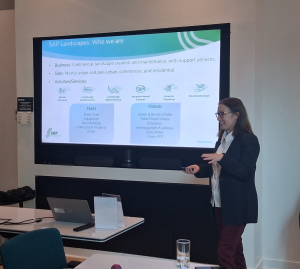
Woman speaks at large screenshowing text in blue boxes and small icons

Under the Corporate Sustainability Reporting Directive (CSRD), Taskforce on Nature-related Financial Disclosure (TNFD) and other guidance such as the Global Reporting Initiative (GRI) and ACT-D, (Assess/Commit/Transform/Disclose), stakeholder engagement is essential for a thorough Double Materiality Assessment process, and critical to any business’ local and global reputation. We were fortunate to have Janice Leonard of SAP Landscapes, above, a business in the next track up, Strategy, present her own journey through DMA and stakeholder engagement, bringing a real-world / learning-by-doing perspective. The SAP Landscapes journey is inspiring, and we all benefited from Janice’s insights, which included the need for steady dedication and the benefits of drawing on the Business for Biodiversity Ireland community within the Nature Strategy Accelerator Programme.

While there is a steep learning curve for many businesses in building awareness and understanding in relation to biodiversity and ecosystems, and the role business is poised to play in driving Nature Positive ambition, Business for Biodiversity Ireland is a reliable support to help businesses of every size and sector work through inter-connections and complexities.

Thanks to all our Action Track businesses for their generosity in sharing their own journeys and we look forward to working with you on the Strategic next phase. Thanks to SAP Landscapes, CIÉ, CIÉ Tours, Cloud Assist, Dublin Airport Authority, FuturEnergy Ireland, Irish Rail, Irish Trees, Scott Cawley Ltd, Shannon Airport, Trinity College Dublin and Watermark.

BFBI Business Programme Lead Dr Catherine Farrell CIEEM, Trinity College Dublin, writes on the process steps around undertaking a Double Materiality Assessment (DMA) to help guide your nature strategy: this article focuses on the ways to understand how businesses interface with nature, highlighting the data needs but also the language of a DMA.

Following from our inspiring and interactive workshop on March 10th (read about it here), alongside colleagues from Deloitte, the Business for Biodiversity Ireland team led the second of our Action Track workshop series on May 20th. While our initial workshop focused on the key elements of what a Double Materiality Assessment (DMA) is (and/or isn’t), especially the value chain, this time we focused on how we can map and track the interface of business with nature.

This involves homing in on ‘the where’ part of the DMA process. In essence, this means gathering your organisation’s location data like maps, and – in tandem – figuring out the other types of data available, what they measure and why. Then its time to focus on how we might use data (which may be freely available as well as company-held) to inform our DMA. Our colleagues from Deloitte shared their DMA journey, highlighting how tools like the TNFD LEAP (Locate, Evaluate, Assess and Prepare), can help bring understanding of our business interfaces with nature to light.

In this article we focus more on data and the language of data and DMA (beware of the acronyms!):

Data: we hear a lot about data these days, but when we’re trying to understand our business impacts and dependencies (how we rely on nature) we really need to focus on data relating to aspects of nature referenced in the nature-related reporting frameworks like CSRD, TNFD, SBTN and GRI.

We can start by breaking these into –

  • Locational data (a map of where we operate – note, start with one part of your value chain and get the hang of it!)
  • What types of habitats or ecosystems are present in those places (the basic type and their extent)
  • What our impact is on these specific areas of ecosystem (how we influence their condition), and
  • How we rely on them (what we need from these ecosystems as inputs, aka ecosystem services to our operations) or impact them.

This helps us Locate, Evaluate and Assess our impacts, dependencies, risks and opportunities, and then Prepare to report (think LEAP). We can do this by using available data on habitats, but -now, a health warning – in Ireland habitat data is quite limited. With some ecological input to help, however, we can gather up what is available, in a useful way.

Language: ecological and nature lingo is nuanced but not beyond our reach. It’s helpful to have someone working with us that can communicate these nuances in a clear, simple way. During our workshop we discovered that acronyms and strange ‘eco’ languages can be off putting initially, but once we get into the flow, we find what we need to know.

Many thanks to Aoife Connaughton and Deloitte for collaborating on this workshop, National Biodiversity Data Centre’s Sarah Kelly, and all our Action Track businesses for participating in our Nature Strategy Accelerator Programme, including CIE and CIE Tours, Cloud Assist, Irish Rail, Irish Trees, Future Energy Ireland, KMK, Scott Cawley Ltd, Shannon Airport, Trinity College Dublin and Watermark Coffee.

BFBI Business Programme Lead Dr Catherine Farrell CIEEM, Trinity College Dublin, writes on the process steps around a Double Materiality Assessment to help guide your nature strategy, the subject of our recent Action Track workshop.

As the birds have started to sing for us every morning again (what a joy!), it’s the right time for our businesses to spring into action. And so, inspired by the stretch in the days, on March 11th the team at Business for Biodiversity Ireland, with help from our friends at Deloitte, launched the first of our three Action Track workshops scheduled for 2025 in Dublin.

Our workshop focused on the key elements of what a Double Materiality Assessment (DMA) is (and isn’t), and why it makes perfect business sense for every organisation to conduct one. Business for Nature has outlined how we can do this through a multi-step, iterative process under the Assess phase of their ACT-D framework

Reporting frameworks and sectoral guidance: With heads spinning after the recent EU Omnibus proposal announcement, we all agreed at the workshop, that even though reporting obligation ‘goal posts and timeframes may change, it’s in everyone’s best interest to understand a) their impacts on nature, and b) nature’s impacts / on our businesses (which in turn, relate to dependencies, but also risks and opportunities). This ‘inward and outward looking’ approach is what puts the ‘double’ in DMA. Thankfully, there is a growing repository of sectoral guidance and case studies, as well as freely available online tools like ENCORE and IBAT that assist businesses to begin the journey of ‘Assess’ with relative ease. In the workshop we talked through CSRD, TNFD, SBTN and GRI, but we reminded ourselves, at the heart of all these frameworks is rolling up the sleeves to understand our business operations, our extended value chains and who we interact with along the way.

Value chains and stakeholders: In a world of global value chains – where does a value chain start and end? We spent a fruitful and insightful couple of hours working through value chains relevant to our businesses present: it was great to see the emerging pictures on flipcharts, and participate in conversations that really helped our collective understanding to grow – particularly in relation to where our greatest impacts and dependencies may lie. This is a critical part of the DMA process.

Our next two Action Track workshops will build on this work, working through tools like the TNFD LEAP (Locate, Evaluate, Assess and Prepare), to help bring our understanding to light.

A big thank you to our supporters and speakers from Deloitte, Arianna Bunello and Sofia Langs, with  support from Aoife Connaughton and Caitlyn Flanagan, BFBI Head of Operations Iseult Sheehy and Head of Research Dr Emer Ní Dhúill, Sarah Kelly, of National Biodiversity Data Centre, Eadaoin Boyle Tobin, Business in The Community Ireland.

Thanks to our Action Track businesses – Emily Riondato, Kate Farrell and Caoimhe Donnelly, of Coras Iompair Éireann; Ken Lyons, CIE Tours; Aine Kirrane, Dublin Airport Authority, Liam O’Neill (and Sean online) of Cloud Assist; Aoife McGovern, Future Energy Ireland; Ailish Duggan, Irish Rail; Bob Hamilton, Irish Trees; David Finane, KMK; Aebhín Cawley, Scott CawleyLtd; Arek Gdulinski, Shannon Airport and David Lawlor, Watermark.

Sign up for Discovery Track or level up to Action Track in the Members Home to gain access to future workshops.

2024 was an eventful year for those of us working in advancing nature action at both national and global level.

The much-contested  EU Nature Restoration Law  was brought in – and the Green Party, which was in Government at the time, with Ireland’s first Minister for Nature Malcolm Noonan, were instrumental in getting it over the line. However, there remains political pushback at home and abroad as we enter 2025 and environmental concerns slip further down the agenda in the face of the cost-of-living crisis, political turmoil and global conflict. 

Extreme weather incidents are putting these concerns squarely back on the agenda for the private sector as we start 2025, particularly in the area of insurance and financial investments. Fears are being raised in the food sector due to the climate and nature crises, and we will likely see tourism, hospitality and retail affected globally, as well as a rise in public health concerns. The latest  WEF Global Risks Report  rates several environment-related risks in prominent positions in their Top 10 for a 10-year analysis, with the risk from biodiversity loss and ecosystem collapse ranked in second place, after extreme weather events. The short-term (2 years) risk analysis ranks extreme weather events in second place, however, the risk from biodiversity loss and ecosystem collapse is not as prominent yet on the short-term list of worries for polled business leaders. This is surprising given that it is now widely understood that biodiverse ecosystems create resilient landscapes and enhance carbon sequestration, lessening the effects of climate change such as extreme weather events. (The Economics of Biodiversity aka the Dasgupta Review, for the UK Treasury in 2021, warns we must start accounting for nature’s contributions in national accounts to inform decision-making for future resilience).

We welcome the announcement of a new Minister of State for Nature, Heritage & Biodiversity, Christopher O’Sullivan TD, at the Department of Housing, Local Government and Heritage, and hope concrete and swift action on nature loss and degradation will be set in motion once Ireland’s National Restoration Plan, being developed by the  National Parks & Wildlife Service  in conjunction with relevant stakeholders, is finalised. The new  Programme for Government  pledges to keep the Infrastructure, Nature & Climate Fund, instigated by the previous government, with plans to pursue more funding at EU level, and delivery of Ireland’s  National Biodiversity Action Plan 2023-2030,  which sees a whole-of-government, whole-of-society approach. We look forward to continuing to work with a number of government departments in developing and implementing actions to support businesses in achieving this. 

Despite an uneven progress following successive global summits on climate and nature, BFBI agrees with recent commentary by Business for Nature’s CEO Eva Zabey that interest levels and discussions on biodiversity within the business and policy world are certainly “maturing and multiplying”. “Tackling complex issues such as biodiversity loss and its interconnections with climate and social equity takes time, where global discussions remain key, even if they don’t always result in the urgent progress we are collectively striving for.

“This requires all of us to act with both urgency and perseverance. We take heart in the progress made over the past 12 months by our fantastic community and partners, and by the growing number of businesses and policymakers committed to building a nature-positive future for all by 2030.”

Zabey lists some key highlights from the past year, including the introduction of the EU’s Corporate Sustainability Reporting Directive (CSRD) in effect for 11,000 companies in 2025.

Over 500 companies have committed to disclosing their nature-related issues to investors using the TNFD recommendations – a 57% increase since the beginning of the year, 30 companies have published dedicated nature strategies through It’s Now for Nature and first mover companies publicly adopted science-based targets for nature. These are encouraging signals of change.”

However voluntary action by businesses is far from the norm, and many organisations still do not understand their impacts and dependencies on nature. There is confusion among Irish companies on the scope of the new reporting rules, with a number of our larger legal firms seeking clarification from the Government on how the legislation is to be applied in Ireland.

It is essential that the new Government and the business sector show leadership in making this the year to accelerate our transition to Nature Positive rather than risk playing catch-up – if you are new to it all, start here on our free Discovery Track with access to the evolving guidance and resources coming your way in 2025, including our free webinar series.

Those keen to make the commitment to put prior learning and resources into action now can join our Nature Strategy Accelerator Programme’s paid Action Track for tailored help to get your reporting on track, and be ready to make real positive impact for your business and for nature. We’ll help you to advance to our Strategy Track and Evolution Track, through our Roadmap to Nature Positive (in alignment with the global Now for Nature Strategy), to maintain a steady path to long-term sustainability.

Get on track HERE.


Want a deeper understanding of your business’ impacts and dependencies on nature? Wondering where to start with nature-related disclosures? Lost in a fog of TNFD / GRI / EFRAG / CRSD alphabet soup? Keen to develop a roadmap to Nature Positive for your business but don’t know where to start?

Business For Biodiversity Ireland is participating in the development of a new module with Trinity College Dublin’s Dr Catherine Farrell titled ‘The Business of Nature Positive’ and are inviting businesses who would be interested and willing to:

  • participate in Trinity Business School undergraduate / student-led research to trial the application of nature-related reporting frameworks and tools, and
  • explore ways to develop a roadmap to Nature Positive.

Businesses rely on many aspects of nature and climate to carry out day-to-day business. Recognising these dependencies, as well as the impacts of business on nature, new reporting requirements under the new EU Corporate Social and Responsibility Directive (CSRD), will fast become a reality for Irish businesses.

In response to the need to build capacity for present and future business needs, Trinity Business School is developing this module to be delivered to 4th year undergraduates in the 2024/2025 academic year and facilitate learning in how to apply and communicate relevant nature-related reporting and disclosure frameworks for businesses, helping to identify steps to nature positive and through these processes assist businesses to integrate nature into decision making.

We expect the input from the business to be by a nominated staff member / sustainability business champion working directly with the TCD students. We expect the work to involve at minimum approximately 8-10 hours in total over a period of 4 months (largely between December and mid-April 2025 – download a breakdown of time and commitment expected via the PDF at the end of the article.)

As a participating business, through engagement in this process, you will have opportunities to:

  • Benefit by receiving bespoke support in kickstarting scoping for a materiality assessment for your business
  • Assistance in taking the first steps in identifying data available / potential data needs for nature related reporting
  • Develop a deeper understanding of your business’ impacts and dependencies on nature,
  • Begin the thought process as to how to develop a roadmap for nature positive for your
    business, and
  • Trial approaches / identify opportunities for communicating nature related issues to
    stakeholders (internal and external).

Once we have an overview of interested businesses (small or large, of any sector), the module coordinator will follow up with a questionnaire to determine your suitability in terms of logistics and availability.

NB: Please submit an expression of interest form HERE.

This call for Expressions of Interest will close in early July.


Business for Biodiversity Ireland offers our members an easy-to-follow Roadmap to Nature Positive –  the Assess Phase covers getting started by making a commitment – and another key step is working out where your business stands within a sectoral and organisational context in order to create a solid biodiversity strategy. To do this, you need to know how to ask the right questions.

BFBI members can access our Business Template which will help map out your business model in terms of inputs, activities and outputs. It has been compiled with our community of practice businesses and cross-referenced with prevailing methodology and standards, such as the Global Reporting Initiative and the TNFD LEAP approach.

The Global Reporting Initiative is an independent, international organisation that provides a global common language to communicate environmental impacts with a suite of standards to help businesses report on various aspects of sustainability across regulatory landscapes.

The BFBI Business Template helps unpack your business model with a series of guiding questions, for example:

– What sector are you active within?
– What type of activities are carried out by your business?
– Where are your activities based geographically?

The template goes on to cover your raw materials, your procurement, your land footprint, your water footprint – with recommended tools to calculate these – as well as, you guessed it, your carbon footprint.

Creating a value-chain map

Then you’ll look through your business and value-chain relationships, with more guiding questions, giving you an opportunity to create a value-chain map. Every business has a value chain – you need to also consider what types of activities are undertaken by those with which you have business relationships?

Think about your sector and theirs – what are the nature challenges at local, regional, and global levels related both to your sector and to that of organisations in your value chain: e.g. deforestation, climate change, water stress, pollution, land use, invasive species, natural resource use?

What are the responsibilities with regards to compliance and regulation? These steps on the Roadmap will allow you to create high-level overviews to identify topics material to your business when it comes to new and existing reporting regulations.

This process must be revisited regularly and in consultation with stakeholders and industry experts. The policy landscape is evolving, reflecting the urgency to take action to mitigate risk from the connected biodiversity loss and climate change crises. It is therefore important to be aware of any policy changes that relate to your business, sector and value chain.

The BFBI platform will be on hand with updates – become a member here to access our full Roadmap to Nature Positive.

Next up: Nature Disclosures – knowing your reporting obligations & choosing the right framework