
Tag Archive for: Nature Benchmark

The World Benchmarking Alliance (WBA) has released the results of their Nature Benchmark which tracks and measures how 750 of the world’s most influential companies are reducing their negative impacts on nature and contributing to the protection and restoration of ecosystems.

WBA is a partner in the EU-funded GoNaturePositive! project, co-ordinated from Trinity College Dublin,  which supported this independent and scientifically rigorous benchmarking process as part of joint efforts to build an evidence base for transformative change towards a nature-positive economy.

EU companies dominate top performers

The results of this Nature Benchmark show that EU-headquartered companies account for 11 of the top 20 best performing companies, rising to 18 out of 20 when companies from the UK, Switzerland and Norway are included. Arla Foods from Denmark is the only private company making it into the top 20, with publicly quoted companies making up the vast majority of top performers.
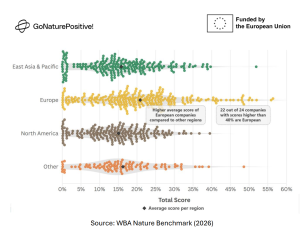
Graph with different colours for each region
WBA reports that across all 750 companies benchmarked, European companies are the global leaders on nature performance, followed by strong performances from South African, Thai, Australian, Japanese and Taiwanese companies. Companies in China, Vietnam and India lag behind, along with those in North and South America.

However, the results also show that the performance bar is low with an average score of 17/100 across all companies, with even the best performing companies scoring under 60/100. Particularly poor performance was noted against indicators which are considered important for transformation towards a nature-positive economy with only 2% of companies disclosing a nature transition plan aligned with the Global Biodiversity Framework or nature-positive principles. These early movers show that some large businesses are starting to embed the concept of nature-positive in their business plans and strategies.

Siobhan McQuaid, Coordinator of GoNaturePositive!, Trinity College Dublin, commented:

“In GoNaturePositive!, we are seeing that while business awareness of nature-related impacts and dependencies is generally low, the financial community and insurance sector are increasingly aware of these risks and are calling for urgent action. We are activating a whole-of-society approach to address these risks – working with businesses, investors, policy makers and communities to accelerate action towards a nature-positive economy.”

Read more on the Nature Benchmark at the World Benchmarking Alliance site.

Need guidance to lead the nature-positive transition in Ireland by developing a Nature Strategy for your organisation? Businesses can now join our Nature Strategy Accelerator Programme, now recruiting for 2026 – sign up here for more information.

The World Benchmarking Alliance has released an updated Nature Benchmark, assessing how more than 800 major companies across varied sectors are impacting nature and protecting and restoring ecosystems.

Using company data and performance from 2022-2024, the research finds that, although some companies are helping to halt and reverse biodiversity loss, the majority do not yet fully understand how they impact and depend on nature. Only 5% of all companies have carried out an assessment of the impact of their operations on nature, and less than 1% have assessed their dependencies on nature.

The research, which explored the performance of companies such as Unilever, Kering and Nestlé, assessed companies across plastics, water stewardship, environmental rights, and board-level accountability, finding worrying gaps in key areas such as water use, ecosystem conversion and respecting local communities’ rights.

Two industries outperformed the rest in terms of ranking: Personal & Household Products, with an average score of 26 out of 100, and Pharmaceuticals & Biotechnology, with an average score of 20.

Nature blind spot: only 5% of companies assess their impact, and less than 1% understand dependencies

Only 5% of companies have carried out an assessment of the impact of their operations on nature. Less than 1% of companies have carried out an assessment of their dependencies on nature. This is worrying, as it means that companies cannot strategically manage and prioritise their actions on nature. Although some companies have started to assess their impacts and dependencies, they often only cover a fraction of their operations or don’t publish the results. They also tend to focus on land or freshwater, neglecting the marine realm. The landscape is rapidly changing – the EU Corporate Sustainability Reporting Directive, which has just come into effect, will require many large businesses to disclose their material sustainability impacts and dependencies from 2025 and will affect smaller companies down the line.

Regardless of their current regulatory requirements, all companies should begin applying a risk management and disclosure framework such as the Taskforce on Nature-Related Financial Disclosures.

You can view and filter companies involved by ranking and sector here: https://www.worldbenchmarkingalliance.org/publication/nature/rankings/

Companies overwhelmingly disregard Indigenous Peoples’ rights

Indigenous Peoples and local communities often live in critical ecosystems and coexist with threatened species. They manage about 40% of all terrestrial protected areas and their ecological knowledge enables a sustainable existence worldwide, yet less than 13% of companies assessed express a clear commitment to respect Indigenous Peoples’ rights.

As water insecurity rises, companies must accelerate their water stewardship

72% of the world’s population is water insecure. Findings show that 29% of companies are reporting water use reductions or disclosing water usage from water-stressed areas, suggesting a growing awareness of their role in ensuring water availability worldwide. However, water scarcity is also about the quality of available water for essential human needs like drinking and bathing. Only 15% of companies are reporting metrics on discharged pollutants, and just 4% have set targets to reduce them.

High risk of greenwashing on plastic, as companies struggle to back up efforts with data

Despite the comparatively high proportion of companies that provide qualitative evidence of working on plastic reduction (43%), their performance significantly drops regarding whether they are providing quantitative metrics (19%) to back these up, and even more so for whether they have a quantitative, time-bound targets (7%) to reduce plastic use and waste.

Increasing board accountability is vital: more leadership needed at the top

While 66% of companies assign sustainability oversight to their boards, only 2% of companies have boards that can demonstrate they have the relevant expertise on topics like biodiversity or climate. It is apparent that companies that demonstrate robust corporate governance score significantly better on other sustainability issues. To enable impact, companies should prioritise developing a sustainability strategy that covers nature, supported by concrete high-level responsibility and accountability for delivering the strategy.

Irish-based companies can start by joining Business For Biodiversity Ireland and getting started on our Roadmap to Nature Positive which will enable your organisation to build a strong biodiversity strategy.

You can visit a Nature Benchmark FAQ here to find out more.

Read the Nature Benchmark HERE.

Join the BFBI Nature Strategy Accelerator Programme HERE.