Tag Archive for: Business For Nature

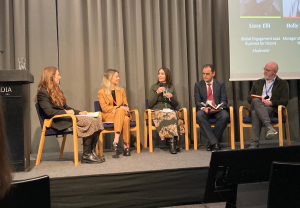
Business For Biodiversity Ireland attended the European Business & Nature Summit 2025 in Helsinki, Finland, on October 23 & 24, 2025, with our Head of Research Dr Emer Ní Dhúill joining a Business For Nature panel on ‘Embedding nature in your business strategy’ alongside Geoff Hamilton, Biodiversity Lead for BFBI Strategy Track members ESB

The event, supported by the EU Business For Biodiversity Platform and Finnish Innovation Fund Sitra, brought together leaders from across Europe to discuss the integration of nature into business strategies, focusing on practical steps, collaboration, and the economic importance of protecting natural capital. BFBI was also represented at the event by Team BFBI members Dr Maria Fitzpatrick (Executive Director), Iseult Sheehy (Head of Operations) and Dr Catherine Farrell (our Business Programme Lead), with thanks to National Parks & Wildlife Service.

The Day 1 Business For Nature session also featured sustainability leaders Anni Vuohelainen (Director Nature, Tetra Pak), Hing Kin Lee, (Group Leead For Nature, NextEnergy Capital), Marie-Morgan Grebente (Nature & Biodiversity Lead, Decathlon), Holly Metcalfe (Manager, Roadmaps to Nature Positive, WBCSD), and Jesus Carrasco Narajo (Biodiversity Global Responsible, Iberdrola) with the panel chaired by Lizzy Elli (Global Engagement Lead, Business For Nature), the discussion covering the challenges facing businesses including gathering biodiversity data, and the need for support for businesses in navigating this evolving space.

“Nature literacy is quite a large barrier for businesses, also getting buy-in from the different parts of an organisation and a lack of expertise in the businesses to enable them to act…”Dr Emer Ní Dhúill, BFBI Head of Research.

“Inaction on biodiversity is the biggest risk. Don’t let perfection be the enemy of good. Act and then change or iterate as more and better data becomes available.”- Geoff Hamilton, ESB

The biggest takeaway was that boosting biodiversity is an economic imperative, as stated by EC Director-General of Environment Eric Mamer in his opening remarks: “Protecting and restoring nature is a strategic economic choice. Europe must invest in what makes our economy resilient. Natural Capital is part and parcel of Europe’s competitiveness. Nature provides the Natural Capital that keeps our economy running.”

Collaboration Is Key
At the Plenary Session 3 panel discussion on Business action for Circular and Bioeconomy, Rolf Ladau, CEO, Paulig Group, emphasised: “You can only achieve a certain degree of change by yourself, to get beyond that you need to work with others. Collaboration is key…When it comes to securing a resilient food value chain in Europe we need to have a predictable regulatory environment…a functioning single market…and a clear, and long-term commitment.”

Heather Grabbe, Senior Fellow of Belgian think-tank Bruegel, commented on how extreme weather is clearly affecting markets, saying the best way to protect ourselves is a rapid move towards circularity while considering our supply and value chains here in Europe with a global lens. “There is an economic justice element – we need to consider the embedded environmental costs in the items we import and their negative impacts in other countries.

Jessika Roswall, Commissioner for Environment, Water Resilience and a Competitive Circular Economy commented: “We need to focus on better regulation and move faster, which is hard in the democratic way that we work. We also need to explain to businesses, which we are sometimes not good at, why we are enacting regulation. We need to have a change of mindset – as politicians, as businesses and consumers.”

New documents launched

The summit also saw the launch of the ‘It’s Now For Nature Pulse’ – a new Business for Nature report reflecting progress in corporate nature strategies, two years on from the launch of It’s Now For Nature Handbook. It shows how businesses are integrating biodiversity into their strategy using the leading frameworks and science-based methods (as aligned with our BFBI Nature Strategy Accelerator Programme as the coalition’s Irish partners.)

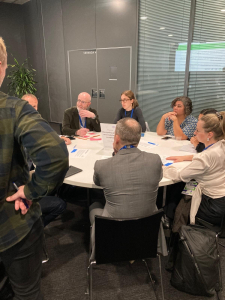
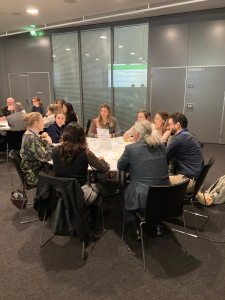
BFBI also participated in the interactive session on Day 2 for the launch of ‘Policy Imperatives for a Competitive and Resilient Nature Positive Economy’ a publication in collaboration with Trinity College Dublin and the European Commission, in conjunction with the Directorate-General for Research and Innovative Horizon Europe and Invest4Nature, to show how embedding nature into policy can secure Europe’s resilience and prosperity through strategic investment, coherent regulation, empowered local engagement and systemic reform. Geoff and our team also joined breakout discussion tables, pictured below, on ‘Navigating policy & stakeholder complexity.”

Horizon Nua Director Siobhan McQuaid moderated the discussion on ‘Rationale and roadblocks for business transformation to nature positive’ while launching the TF3 EC Expert publication which features new research and case studies from over 40 EU-funded projects.  Co-authored by Siobhan and Horizon Nua EU Project Manager Martina Brophy, it sets out both the reasons and challenges for nature-positive transformation from a business and policy perspective. Access the new publication HERE.

The lively two days of discussion and networking rounded off with a dialogue by EU Commission Director of Biodiversity Humberto Delgado Rosa. EBNS2025 was streamed live –  you can watch the recordings HERE.

Business For Biodiversity Ireland is here to support Irish businesses to meet the challenges of boosting resilience through nature action. To find out more about our Nature Strategy Accelerator Programme, sign up today or email our Executive Director Maria Fitzpatrick – our intake is open for 2026!

The BFBI team is looking forward to joining Business for Nature at the European Business and Nature Summit 2025 on October 23rd in Helsinki, Finland.

The Irish contingent will be out in force with BFBI’s Dr Emer Ní Dhúill participating in a session led by  Business For Nature’s Head of Global Engagement, Michael Ofushene-Wise and Global Engagement Lead Lizzy Elli, on helping businesses to embed nature into their business strategy. The panel will also feature Geoff Hamilton, Biodiversity Lead of Irish electricity provider ESB, one of the BFBI member organisations making great progress on the Strategy Track on the BFBI Nature Strategy Accelerator Programme for Irish businesses making the move to #NaturePositive. Fellow speakers include Director Nature for Tetra Pak Anni Vuohelainan, Kasha Foster, Snr Manager Nature Action for WBCSD, Marie Morgan Grebent, Nature & Biodiversity Project Lead, Decathlon, Hin Kin Lee, Group Lead For Nature, Next Energy Capital.

With Iberdrola, Sitra and the EU Business & Biodiversity Platform: https://ebns-events.com/

Registration is now closed but are you attending the summit? Reach out to connect if so!

Dr Maria Fitzpatrick – manager@businessforbiodiversity.ie
Dr Emer Ní Dhúill – Emer.NiDhuill@businessforbiodiversity.ie

Following on from earlier Strategy Track workshops, where we focused on the key elements of what a Nature Ambition Statement is (and why every organisation should have one!) and how to set SMART nature targets, BFBI Business Programme Lead Dr Catherine Farrell CIEEM, Trinity College Dublin, writes on the final in-person workshop of 2025 for our businesses in this track where we outlined how to bring all the different components together.

In our first workshop of the year, we outlined the need for in-depth understanding of our business impacts and dependencies on nature, and importantly, where these occur along the business value chain. Armed with insights to our value chain and following the steady guidance of the ACT-D framework  (along with resources such as the WWF Corporate Nature Targets publication, and the Science Based Targets Network framework (with lots of great resources / videos), we began to think about targets.

But, exploring the idea of targets unlocks a whole suite of ensuant questions – should our targets be based on actions or outcomes; resources applied or timeline to get there; and which part of the value chain should we focus on?

Our advice? Stop, take a deep breath and focus on one impact to start with. What could we do to enhance biodiversity at our direct operations? Could we then look further and think about procurement of raw materials – could we set a target to work with our suppliers and collaborate to reduce impacts / drivers of biodiversity loss at source?

Once we start exploring and collaborating, the innovation begins. And innovation is what drives sustainable business forward, to future proof and avoid nature related risk.

The challenge then lies in monitoring and reporting: rather than re-invent wheels take a practical approach and measure what matters, where; and build from there. In our workshop, we explored natural capital accounting methods to build information – showing how knowledge of the stocks and flows help inform decision making and importantly transition planning. Checking how we communicate these targets relative to our Nature Ambition Statement will help to keep us on course.

The team at Business for Biodiversity Ireland extend their gratitude to the Sustainable Futures team at KPMG; thanks also to our hosts Bank Of Ireland, for looking after us at their Baggot Street Head Office. As previous, we followed the guidance for the accelerator programme for businesses set out by Business for Nature under the Commit phase of their ACT-D framework.

Join the Nature Strategy Accelerator Programme for 2026! Sign up on our site or contact our Business Development Manager Dr Maria Fitzpatrick to discuss the options for your business: manager@businessforbiodiversity.ie


Following from our kick-off Strategy Track workshop in January where we focused on the key elements of what a Nature Ambition Statement is (and why every organisation should have one!), BFBI Business Programme Lead Dr Catherine Farrell CIEEM, Trinity College Dublin, writes on the next workshop for our businesses on this track – where we outlined how to set SMART nature targets to underpin businesses’ nature strategies.

In our first workshop, we outlined the business need for a deep understanding of impacts and dependencies on nature, and importantly, where these occur along the business value chain. Focusing on our greatest impacts and dependencies on nature is an effective first step towards setting targets to both reduce the impacts, and – critically – to reduce potential financial risks and leverage opportunities at the same time. Risks arise when we are dependent on ecosystem services (also referred to as ‘nature’s contributions to people‘), but the continued flow of those services (perhaps from upstream in our value chain, as in the provision of raw materials), might well be reduced due to an affect beyond our control (think changing weather patterns on crops, for example).

Specific, Measurable, Attainable, Relevant and Time-bound nature targets
And so, armed with this understanding of our value chains, we worked through the process of setting SMART (Specific, Measurable, Attainable, Relevant and Time-bound) nature targets for the businesses present at our workshop. We covered some key elements such as: targets can be generic, broad, and/or highly specific; they can be action- or outcome-focused, short or long-term, but they must always relate to the value chain. Importantly, if we are to set SMART targets, they must be resourced and matched by indicators to track progress. Thankfully, there is a range of useful guidance out there, such as the WWF Corporate Nature Targets publication, and the Science-Based Targets Network framework (with lots of great resources and videos).

As previously, we followed the guidance for the accelerator programme for businesses as set out by Business for Nature under the Commit phase of their ACT-D framework.

Setting targets may seem daunting, but if we focus on one aspect of our value chain to start with, and work through the process, then this builds familiarity and confidence in the process. At our next workshop for this track later in the year, we will focus on how to monitor, evaluate and disclose progress towards our nature targets, and how they link to other sustainability targets.

The team at Business for Biodiversity Ireland wish to extend our gratitude to Thomas Ball and Ellen Cunningham, of the KPMG Ireland Sustainable Futures Nature & Land Use Unit for supporting us in delivering this workshop. Thanks also to our host Geoff Hamilton and ESB for looking after us at their Fitzwilliam Square Head Office in Dublin. Many thanks to our associates in the National Biodiversity Data Centre and Business in the Community Ireland, and to all the businesses in our Strategy Track including An Post, ESB, Bank of Ireland,  Bus Éireann, Cairn Homes, Glenveagh Properties, Gas Networks Ireland and SAP Landscapes for doing this important work with us.

Group of people in a boardroom, some kneeling to fit in the frame

BFBI Business Programme Lead Dr Catherine Farrell CIEEM, Trinity College Dublin, who presented at our recent Stategy Track workshop in Dublin, recaps on the benefits of developing a Nature Ambition Statement to help guide your nature strategy.

It’s is the perfect time to set targets for the coming year. And so, in the spirit of setting a steady nature-positive pace, the team at Business for Biodiversity Ireland, with help from the Sustainable Futures team at KPMG Ireland, kicked off 2025 with an insightful January workshop for our Strategy Track businesses.

Our focus was on the key elements of what a Nature Ambition Statement is – and why every organisation should have one. BFBI, in partnership with Business for Nature, is hosting the It’s Now for Nature Accelerator programme to empower Irish businesses to develop and publish a credible nature strategy.

Step 1: So, you’ve done your basic value-chain mapping, you’ve identified your main impacts and dependencies, and you’ve found that biodiversity is a material topic for your business to include in annual reporting. In the process, you’ve highlighted key areas to focus on, and you have a sense of what you can achieve. Maybe you also discovered areas that your employees or customers want you to focus on. But you need a North Star to guide your next steps. That is what your Nature Ambition Statement is.

There are some good examples available to learn from, such as the ambition statement developed by Foresight Group, and Business for Nature has provided some good guidance around elements that should be included – such as, how your ambition aligns with the Global Biodiversity Framework targets and timelines for delivery. 

Step 2: The ambition, set out in Step 1, can only be achieved if it is supported by setting targets that can be realised. We need to be thinking about targets that are SMART – specific, measurable, achievable, relevant and time-bound; being clear on what is achievable and within what timeframes. This will be the focus of our next two Strategy Track business workshops coming up later in the year.

In a nutshell, a Nature Ambition Statement sets the coordinates for where your business needs to, and importantly, wants to, go for nature. It can be used to help guide the target-setting process within the company but it also sends a clear, action-oriented message to your customers and key stakeholders. The process itself – agreeing and refining the business’ nature ambition – could also be described as the first step in business transformation.

The next step is getting clear on what the business can do, and what it is ready to commit to, towards a nature-positive future. More on this to come in our next workshop in April.

Our Strategy Track includes pilot BFBI businesses who have been progressing their organisation’s Nature Strategy and sharing feedback along the way, including An Post, Bank of Ireland, Bus Eireann, Cairn Homes, ESB Networks, Gas Networks Ireland, Glenveagh Properties, KPMG Ireland’s Sustainable Futures, SAP Landscapes and our associates at Business in The Community Ireland, Biodiversity Data Centre and Trinity College Dublin.

  • To take the first step on the BFBI 4-Track Nature Strategy Accelerator Programme, your organisation can sign up for our free Discovery Track. Once you have a good handle on what’s needed for your business to begin to take action, you can sign-up to progress along the paid Action Track, then the next step will be the Strategy Track.

Read more here – How It All Works.

2024 was an eventful year for those of us working in advancing nature action at both national and global level.

The much-contested  EU Nature Restoration Law  was brought in – and the Green Party, which was in Government at the time, with Ireland’s first Minister for Nature Malcolm Noonan, were instrumental in getting it over the line. However, there remains political pushback at home and abroad as we enter 2025 and environmental concerns slip further down the agenda in the face of the cost-of-living crisis, political turmoil and global conflict. 

Extreme weather incidents are putting these concerns squarely back on the agenda for the private sector as we start 2025, particularly in the area of insurance and financial investments. Fears are being raised in the food sector due to the climate and nature crises, and we will likely see tourism, hospitality and retail affected globally, as well as a rise in public health concerns. The latest  WEF Global Risks Report  rates several environment-related risks in prominent positions in their Top 10 for a 10-year analysis, with the risk from biodiversity loss and ecosystem collapse ranked in second place, after extreme weather events. The short-term (2 years) risk analysis ranks extreme weather events in second place, however, the risk from biodiversity loss and ecosystem collapse is not as prominent yet on the short-term list of worries for polled business leaders. This is surprising given that it is now widely understood that biodiverse ecosystems create resilient landscapes and enhance carbon sequestration, lessening the effects of climate change such as extreme weather events. (The Economics of Biodiversity aka the Dasgupta Review, for the UK Treasury in 2021, warns we must start accounting for nature’s contributions in national accounts to inform decision-making for future resilience).

We welcome the announcement of a new Minister of State for Nature, Heritage & Biodiversity, Christopher O’Sullivan TD, at the Department of Housing, Local Government and Heritage, and hope concrete and swift action on nature loss and degradation will be set in motion once Ireland’s National Restoration Plan, being developed by the  National Parks & Wildlife Service  in conjunction with relevant stakeholders, is finalised. The new  Programme for Government  pledges to keep the Infrastructure, Nature & Climate Fund, instigated by the previous government, with plans to pursue more funding at EU level, and delivery of Ireland’s  National Biodiversity Action Plan 2023-2030,  which sees a whole-of-government, whole-of-society approach. We look forward to continuing to work with a number of government departments in developing and implementing actions to support businesses in achieving this. 

Despite an uneven progress following successive global summits on climate and nature, BFBI agrees with recent commentary by Business for Nature’s CEO Eva Zabey that interest levels and discussions on biodiversity within the business and policy world are certainly “maturing and multiplying”. “Tackling complex issues such as biodiversity loss and its interconnections with climate and social equity takes time, where global discussions remain key, even if they don’t always result in the urgent progress we are collectively striving for.

“This requires all of us to act with both urgency and perseverance. We take heart in the progress made over the past 12 months by our fantastic community and partners, and by the growing number of businesses and policymakers committed to building a nature-positive future for all by 2030.”

Zabey lists some key highlights from the past year, including the introduction of the EU’s Corporate Sustainability Reporting Directive (CSRD) in effect for 11,000 companies in 2025.

Over 500 companies have committed to disclosing their nature-related issues to investors using the TNFD recommendations – a 57% increase since the beginning of the year, 30 companies have published dedicated nature strategies through It’s Now for Nature and first mover companies publicly adopted science-based targets for nature. These are encouraging signals of change.”

However voluntary action by businesses is far from the norm, and many organisations still do not understand their impacts and dependencies on nature. There is confusion among Irish companies on the scope of the new reporting rules, with a number of our larger legal firms seeking clarification from the Government on how the legislation is to be applied in Ireland.

It is essential that the new Government and the business sector show leadership in making this the year to accelerate our transition to Nature Positive rather than risk playing catch-up – if you are new to it all, start here on our free Discovery Track with access to the evolving guidance and resources coming your way in 2025, including our free webinar series.

Those keen to make the commitment to put prior learning and resources into action now can join our Nature Strategy Accelerator Programme’s paid Action Track for tailored help to get your reporting on track, and be ready to make real positive impact for your business and for nature. We’ll help you to advance to our Strategy Track and Evolution Track, through our Roadmap to Nature Positive (in alignment with the global Now for Nature Strategy), to maintain a steady path to long-term sustainability.

Get on track HERE.


Business for Biodiversity Ireland (BFBI) was invited to attend the in-person and semi-virtual European Business and Nature Summit (EBNS) in Milan on the 11th and 12th of October 2023. BFBI’s Platform Development lead Lucy Gaffney and researcher Emer Ní Dhúill attended the summit – Europe’s foremost high-level political and technical forum, dedicated to mobilising the business community towards achieving the nature-positive goal – and returned with some key takeaways:

On Day 1, the BFBI team attended the Opening Address by EU Commissioner for the Environment Virginijus Sinkevicius, as well as the inspirational keynote by Climate Scientist and Explorer Gilles Denis, also the high level policy and business dialogues and a number of workshop parallel sessions. In addition, the team attended a side event facilitated by KPMG Italy and moderated by Orlaith Delargy of KPMG Ireland, which focused on CSRD and included a guest speaker from the sustainability team at Italian Coffee company Illy Caffe.

Workshop: GBF’s Target 15 as a catalyst for action

“Target 15. Businesses assess and disclose biodiversity dependencies, impacts and risks, and reduce negative impacts” (Kunming-Montreal Global Biodiversity Framework (GBF), Convention on Biological Diversity)

Target 15 of the Global Biodiversity Framework places nature conservation on equal footing with both profit and climate change by exhorting businesses to disclose their dependencies on and impacts to biodiversity. Yet achieving the promise of Target 15 will require new processes and tools. This session explored three such critical areas: how can companies use transition plans to accelerate progress on both nature and climate goals, how can financial institutions take responsibility and amplify this essential work, and how can Target 15 complement and improve the Paris Agreement’s stocktake of progress on climate goals?.

Key Takeaways:

This workshop included a panel discussion on business finance and government, including the need for alignment with financial flows. This session included speakers from the European Commission, the French Treasury, Orkla ASA, and Arcadis.

The need to redirect capital flows was mentioned, in particular that it should include public and private capital. It was highlighted that those who are the custodians of nature should be rewarded. The need to avoid and reduce negative impacts on nature was noted as a key part of Target 15 – ‘you can’t just restore nature, you must reduce and avoid impacts’.

Participants were divided into groups to discuss Target 15. Points raised included:

  • The link between biodiversity loss and climate change should be clearly stated, including an understanding that actions for biodiversity can mitigate the impacts from climate change.
  • Nature must be integrated with climate – this includes the synergies and trade-offs.
  • There is a need for transformative change to nature positive in order to achieve Target 15.
  • There is a need to disclose impacts and dependencies, but actions should also be disclosed.
  • Transition plans need to be well thought out, transparent, and identify action gaps.
  • The need to data standardisation was highlighted.
  • The timeline for Transition Plans was discussed, with it generally agreed that they should have long-term actions (at least to 2050), but in reality, the duration is short-term.
  • For nature, the location/landscape level is important for setting nature-positive goals. The sector level works well for climate action, but for biodiversity, the landscape level is more important. However, a good high-level starting point is the Sector Actions Towards a Nature-Positive Future developed by Business for Nature.
  • Although the location/landscape level for nature was considered important, it was highlighted that investors invest in sectors, not locations/landscapes. Consideration needs to be given to this and how to get investors to change that mindset – with a suggestion that investors go back to their clients and inform them of the need to assess impacts and dependencies at the location/landscape level along the value chain of a given portfolio.
  • The need to look at companies within sectors and what they doing was noted, with the aim of separating the leaders from the laggards.

Creating a credible roadmap to a nature-positive economy: how to avoid green-washing and ensure real outcomes for biodiversity

The session provided introductory information for businesses to action nature-positive ambition now. Providing real-world examples of actions being taken by leading corporations, with a focus on setting organisational biodiversity targets, measuring and accounting for impacts, and working to improve value-chain transparency. This session included speakers from Etifor, Fauna & Flora, BancaEtica, Salesforce, NextEnergy and NESTE and was moderated by Wesley Snell from Etifor.

Key Takeaways:

  • Businesses need to understand how they interact with commodity markets.
  • There is an understanding that we cannot eliminate harm completely, but that we need to operate within planetary boundaries
  • Biodiversity only applies to Scope 1 and 3
  • There is a general lack of biodiversity knowledge in the business community
  • There are key mindset challenges that exist in business
  • Getting internal buy-in can be a real stumbling block.


On Day 2, the BFBI team attended the opening address by Florika Fink-Hooijer, EC Director General for the Environment, the high-level policy and business dialogue 3 and a number of workshop sessions, as well as the closing plenary.

Sector transition pathways to nature positive

Following the adoption of the Global Biodiversity Framework, various business initiatives including Business for Nature (BfN), WBCSD and WEF have started identifying a set of sector-specific actions that business can take to contribute to a nature positive future. Drawing on the outcome of this work, this session identified common barriers and challenges currently preventing business action and impeding sector transition. As the momentum around business and biodiversity continues to increase globally, the session also identified policy levers to accelerate and scale up nature-positive sector transformation and opportunities to finance business innovations and models across the economy that protect and restore nature.

Moderated by Eva Zabey, CEO of Business for Nature, this was an audience-led session and after some brief panel questions, discussion was thrown out to the floor. The topic was “challenges facing businesses when it comes to taking or scaling action”. BFBI’s Lucy Gaffney intervened, stating that one of the main challenges involves dismantling the current ideals and thinking around corporate biodiversity actions, traditional activities like wildflower meadows and beehives, and rebuilding corporate perspectives around biodiversity strategies. The intervention was well received and prompted numerous conversations at the networking break.

Business for Nature announced a new campaign called “It’s Now for Nature” launching on November 9th, a rally cry to business to act on nature and contribute to nature positive world by 2030.

Biodiversity certificates and credits: an opportunity for forests, coastal habitats, and local communities?

Biodiversity credits and certificates offer a chance to accelerate the transition to a nature-positive society. All actors and market participants need to be involved in the design of emerging biodiversity schemes, understanding the challenges and conditions for developing a high integrity and scalable voluntary biodiversity credits framework that supports business in their journey towards nature positive. The session aimed to showcase emerging initiatives in this space, focusing on measuring, certifying, and trading of credits. By gathering different viewpoints from policy, science, and business, the session aimed to help demonstrate the multiple forms of expertise that are needed.

Key Takeaways

This session included speakers from ItaSIF – Forum per la Finanza Sostenibile, World Economic Forum, CDC Biodiversité, European Commission Joint Research Centre, NatureMetrics, Forest Stewardship Council International (FSC) and Etifor. Key takeaways from this session:

  • Biodiversity credits are not a silver bullet and not the solution to the biodiversity loss crisis – however they are an important and useful tool that can be employed.
  • Other mitigation measures need to be implemented before considering biodiversity credits.
  • Biodiversity credit claims need to be realistic and need to protect consumers from greenwashing – the Green Claims Directive was highlighted.
  • The TNFD and SBTN guidance were mentioned as important resources.
  • There is a need for standardised, verifiable data, including data on impact reductions and finance data.
  • There is a need for pressure data and on-the-ground data.
  • Data needs to be stored to be available long-term (aka a data hub).
  • Metrics for ecological equivalence similar to those of carbon equivalence are needed.
  • Criteria need to be measurable (carbon farming was mentioned).
  • Biodiversity is location specific, the metrics used in one location may not be appropriate for another location – this is a challenge.
  • Tools developed for nature metrics need to be aligned to the stakeholders needs/ability. However, there is a cost associated with developing such tools (i.e. NatureMetrics).
  • It was highlighted that there are numerous biodiversity credit standards but only a handful of projects.
  • Offsetting should be regulated, not voluntary.

Transforming the global food system: Establishing successful partnerships to engage all actors in the value chain

This session focused on tested tools and approaches for creating and maintaining successful inclusive value-chain collaboration to reach agrobiodiversity objectives in different contexts. Speakers included representatives from Nestle, Lidl, the Italian Farmers Association, the Cool Farm Alliance and Coldiretti Bio.

Key Takeaways

  • Food is an ecosystem service, biodiversity is the lubricant
  • The latest CAP is designed for productivity but some money is earmarked for climate and biodiversity
  • Businesses must focus on reducing negative externalities, reducing food loss and waste, educating consumers
  • Less nature = less food
  • Food is big business in Europe. The growing global population is putting huge pressures on food systems.
  • Farmers need to be part of the conversation – most farmers (in Italy) are small farmers with limited time and resources (this would hold true for Ireland too)
  • There is a need for common targets such as the EU Green Deal (EU Biodiversity Strategy and Farm to Fork) targets for reducing pesticide use
  • There is a legislative framework on food in progress at the EU Commission which focuses on soil health (soil underpins all sustainability in the food sector)
  • A big strength of food security is the ecosystem services provided
  • Tech drives investment, but eco-tech (including Nature-based Solutions) are also important
  • The EU are the standard setters and have influence on the global stage
  • Regarding the Nature Restoration Law, it was noted that some stakeholders feel threatened although the aim of the NRL is for the benefit all stakeholders.

BFBI platform lead Lucy asked a question around a 2020 UNEP report which states that the business models of primary producers will be more likely to shift towards nature positive if the value chain pays for the outcome. How likely are businesses within the value chain to finance their upstream primary producers to become more nature positive and how can we mobilise finance from within the value chain instead of consistently relying on the public purse?

Conclusion

The 2023 summit was about turning commitments into action and catalysing business activities that will support the Global Biodiversity Framework. There were certainly more businesses in attendance compared to 2022 and there were many examples of businesses taking action illustrated throughout the workshop sessions. The European Commission also had a larger delegation this year.

Several interventions were made by the BFBI team which highlighted our platform and our team. The opportunities for networking were vast and BFBI made some very important connections that will enhance our offering to business in the future by having access to experts and business examples that are well on their way to becoming nature positive.

Read more: European Business and Nature Summit Conference 2023

A major collaborative initiative has been launched aimed at driving alignment around the term ‘nature positive’ in order to support broader, longer-term efforts to deliver nature-positive outcomes. Read the full definition of Nature Positive here.

The Nature Positive Initiative includes Business for Nature, Capitals Coalition, the Global Reporting Initiative and the Taskforce on Nature-Related Financial Disclosures. The development of ‘Nature positive by 2030’ as the global goal for nature – equivalent to the 1.5C goal that exists for climate, has been ongoing since 2019.

This goal refers to halting and reversing biodiversity loss by 2030 from a 2020 baseline, through measurable gains in the health, abundance, diversity and resilience of species, ecosystems, and natural processes.

The Nature Positive Initiative states: “Governments, business and civil society have rallied behind the ambition inherent in a nature-positive approach, with reversing biodiversity loss recognised as critical to combating the global climate crisis, preventing future pandemics, addressing water and food insecurity, supporting sustainable and equitable development, and recognising and addressing the rights and contributions of Indigenous Peoples.

“In December 2022, the goal was codified in the mission of the landmark Kunming-Montreal Global Biodiversity Framework, with its adoption under the UN Convention on Biological Diversity described as the ‘Paris moment’ for nature.

“At the same time, use of the term ‘nature positive’ has grown without a clear and aligned understanding among business, finance, government and civil society actors about what the phrase represents and does not represent. Ensuring clarity and preserving the integrity of the definition is now a priority to ensure the necessary actions and accountability.

“A priority will be supporting the rollout of the common definition, metrics and standardised tools and practices that enable all to appropriately measure and report on their impact and contributions at the actor level. The initiative will also advocate for and support the full implementation of the Kunming-Montreal Global Biodiversity Framework by governments and other stakeholders.”

Organisations involved include African Natural Capital Alliance, BirdLife International, Campaign for Nature, Conservation International, Global Commons Alliance, ICLEI – Local Governments for Sustainability, Indigenous Information Network, InTent, IUCN (International Union for Conservation of Nature), Nature Positive Universities / University of Oxford, Nature4Climate, NatureFinance,  Potsdam Institute for Climate Impact Research, Principles for Responsible Investment, Science Based Targets Network, The Climate Champions Team, The Nature Conservancy, The Pew Charitable Trusts, Wildlife Conservation Society, World Business Council for Sustainable Development, IUCN World Commission on Protected Areas, World Resources Institute, and WWF International.

This core group of organisations will be tasked with setting the NPI’s strategic direction, policy positions, and joint activities. They will also be responsible for convening and coordinating to ensure all stakeholders’ views are considered and to help support efforts to deliver nature-positive outcomes across society. An NPI Partnership is open to all relevant institutions and organisations who want to support and implement the global goal for nature.

For further information on the Nature Positive Initiative, please contact naturepositiveinitiative@gmail.com.

See https://www.naturepositive.org/

Tag Archive for: Business For Nature