With demand for disclosure of corporate biodiversity performance growing in accordance with new EU regulations, several biodiversity disclosure frameworks, regulatory and voluntary, have now been published or are under development.

However, despite good efforts being made to align these initiatives, it is not always immediately clear how these various biodiversity disclosure initiatives differ and overlap.

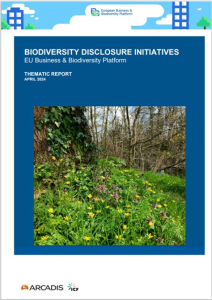
A Thematic Report on Biodiversity Disclosure has been developed by our colleagues in the EU Business and Biodiversity Platform in collaboration with consultancy Arcadis. It focuses on biodiversity within the respective disclosure initiatives and highlights the major differences and similarities, covering six biodiversity disclosure initiatives, three of which are regulatory (CSRD – ESRS E4, SFDR, French Article 29) and three which are voluntary approaches (TNFD, GRI, CDP).

Download the report HERE.

Cover of report with white title text on dark blue background with a photo of a woodland with ivy covered trees and yellow flowers

After months of wrangling, the Nature Restoration Law has finally been enshrined into EU regulation after a last minute change of heart by Austrian Green Minister Leonore Gewessler, who defied her conservative coalition colleagues to cast a deciding vote in favour.

The new law, voted in by the majority of member states after months of tense negotiations, was strongly backed by Ireland’s Minister of State for Nature Malcolm Noonan and Minister for the Environment Eamon Ryan, as well as boosted by major campaigns by groups of science and businesses leaders. It sets a target for the EU to restore at least 20% of the EU’s land and sea areas by 2030 and all ecosystems in need of restoration by 2050.

The law will help achieve the EU’s climate and biodiversity objectives and enhance food security. Member states will have to adopt national restoration plans detailing how they intend to achieve targets, with Ireland’s plan currently being developed by National Parks & Wildlife Services.

Agriculture ecosystems

To improve biodiversity in agricultural ecosystems, EU countries will have to make progress in two of the following three indicators: the grassland butterfly index; the share of agricultural land with high-diversity landscape features; the stock of organic carbon in cropland mineral soil. Measures to increase the common farmland bird index must also be taken as birds are good indicators of the overall state of biodiversity.

As restoring drained peatlands is one of the most cost-effective ways to reduce emissions in the agricultural sector, EU countries must restore at least 30% of drained peatlands by 2030 (at least a quarter shall be rewetted), 40% by 2040 and 50% by 2050 (where at least one-third shall be rewetted). Rewetting will remain voluntary for farmers and private landowners, with work already under way in Ireland by Bord Na Móna permitting Ireland to reach our targets.

Read more on the EU Parliament website.

Want a deeper understanding of your business’ impacts and dependencies on nature? Wondering where to start with nature-related disclosures? Lost in a fog of TNFD / GRI / EFRAG / CRSD alphabet soup? Keen to develop a roadmap to Nature Positive for your business but don’t know where to start?

Business For Biodiversity Ireland is participating in the development of a new module with Trinity College Dublin’s Dr Catherine Farrell titled ‘The Business of Nature Positive’ and are inviting businesses who would be interested and willing to:

  • participate in Trinity Business School undergraduate / student-led research to trial the application of nature-related reporting frameworks and tools, and
  • explore ways to develop a roadmap to Nature Positive.

Businesses rely on many aspects of nature and climate to carry out day-to-day business. Recognising these dependencies, as well as the impacts of business on nature, new reporting requirements under the new EU Corporate Social and Responsibility Directive (CSRD), will fast become a reality for Irish businesses.

In response to the need to build capacity for present and future business needs, Trinity Business School is developing this module to be delivered to 4th year undergraduates in the 2024/2025 academic year and facilitate learning in how to apply and communicate relevant nature-related reporting and disclosure frameworks for businesses, helping to identify steps to nature positive and through these processes assist businesses to integrate nature into decision making.

We expect the input from the business to be by a nominated staff member / sustainability business champion working directly with the TCD students. We expect the work to involve at minimum approximately 8-10 hours in total over a period of 4 months (largely between December and mid-April 2025 – download a breakdown of time and commitment expected via the PDF at the end of the article.)

As a participating business, through engagement in this process, you will have opportunities to:

  • Benefit by receiving bespoke support in kickstarting scoping for a materiality assessment for your business
  • Assistance in taking the first steps in identifying data available / potential data needs for nature related reporting
  • Develop a deeper understanding of your business’ impacts and dependencies on nature,
  • Begin the thought process as to how to develop a roadmap for nature positive for your
    business, and
  • Trial approaches / identify opportunities for communicating nature related issues to
    stakeholders (internal and external).

Once we have an overview of interested businesses (small or large, of any sector), the module coordinator will follow up with a questionnaire to determine your suitability in terms of logistics and availability.

NB: Please submit an expression of interest form HERE.

This call for Expressions of Interest will close in early July.


Calling all Irish businesses! Irish and European policy is moving us all toward nature-positive business models and we want to make sure Irish businesses have all the support they need to comply. This short survey will help you to identify the skills, knowledge and competencies that may not yet be represented in your business. 

The results of the survey will allow us to make recommendations to the Skills and Labour Market Research Unit and other relevant entities to ensure the creation of robust interdisciplinary training and educational options to help businesses meet new nature-related reporting responsibilities and accelerate Ireland’s transition to a nature-positive economy.

In partnership with Trinity College Dublin and National Parks and Wildlife Service, this skills gap survey will support Ireland’s National Biodiversity Action Plan (NBAP) 2023-2030.

Please take the survey here – SURVEY LINK

Business For Biodiversity Ireland is pleased to announce that we are joining the Nature Positive Forum.

We are committed to helping secure a nature-positive world – one where there is more biodiversity in 2030 than there was compared to the 2020 baseline – no mean feat considering the rate at which our biodiversity is being degraded and destroyed by human activity and its effect on climate change.

The purpose of the Nature Positive Initiative is to stimulate and support the world in addressing the accelerating biodiversity crisis by meeting the crucial goal of “halting and reversing biodiversity loss by 2030 from a 2020 baseline and to set the path for full recovery of nature by 2050″. 

The purpose of the Nature Positive Forum is to mobilise a global community, and is open to all relevant institutions, organisations and companies who:

● Commit to upholding the “Global Goal for Nature – Nature Positive“.

● Actively contribute to the Initiative’s goal and objectives in their own activities, and
contribute to and promote its guidance and positions

Read more about Nature Positive Initiative here.
Find out about the Nature Positive Forum here.

Our Roadmap to Nature Positive will help you set the right foundations for reporting your nature-related impacts and dependencies under new regulations – it’s also useful if you are considering reporting these voluntarily.

Regardless of current legal obligations, there is a responsibility for all organisations, no matter their size, to understand their impacts and dependencies on nature and take measures to halt and reverse these. Business as usual is not an option, given the decline in global biodiversity and the interlinked climate crisis, the effects of which are already being felt on human health and society, as well as economically. 

First off, you need to know your obligations on nature disclosures. Within the Roadmap – available to BFBI members when you sign up and log in to the Members Area of our site – we look at reporting for different business types and scales. We also outline the relationship between EU Taxonomy and the Corporate Sustainability Reporting Directive (CSRD).

Goal 3 provides information on your legal obligations, in particular if your business falls under the scope of CSRD; and if/when your business needs to start reporting. There is a different timeline for companies of various scales, starting in 2024 for certain companies. For businesses that do not currently fall under the scope of CSRD, we outline how it may relate to your business down the line.

Considering the value chain

Many businesses that are not within the scope of CSRD are still part of the value chain (aka Scope 3) of larger organisations. These larger organisations may well request Environmental, Social and Governance (ESG) information from their value chain members – and organisations who are not ready for this may find that they lose out when it comes to larger organisations making supplier choices.

Once you know your obligations under the new regulations, the next step will be to explore the reporting standards to find the best fit for your business. Members can check out our Guidance A3.2 on Standardising Reports. Standardised reporting helps organisations increase transparency and communicate their sustainability initiatives.

We’ll give you an overview of the reporting standards that are internationally recognised and aligned with each other with explainers on how all the emerging different policies, frameworks and standards are linked.

Already feeling the overwhelm? Take a breath and have a look at our easy-to-read member guidance documents to give yourself a basic understanding. You’re not expected to be an expert right away and the Platform is here to help. If you have questions, all members are invited to our quarterly Member’s Forum, and you can upload your questions or comments to the online dashboard so that we can discuss them at our meet-ups.

Register here: https://businessforbiodiversity.ie/register-all/

Materiality is the quality of being relevant or significant, and in terms of business and finance, materiality applies to all items that must be recorded or reported in detail in a business’s financial statements as reasonably likely to impact investors’ decision-making. 

Double materiality: For corporate sustainability reporting, the concept of double materiality applies – it goes beyond that which affects the company and its investors, extending to information on how the firm is impacting society and the environment. 

The EU Corporate Sustainability Reporting Directive (CSRD) mandates a double materiality assessment for around 50,000 reporting companies from 2024 onwards. 

The European Sustainability Reporting Standards (ESRS) explains that a double materiality assessment takes two perspectives, sometimes referred to as an ‘outside in’ / ‘inside out’ approach: 

              (1) an impact perspective “when it pertains to the [entity’s] material actual or potential, positive or negative impacts on people or the environment over the short-, medium- and long-term”; and 

              (2) a financial perspective “if it triggers or could reasonably be expected to trigger material financial effects on the [entity].” 

A double materiality assessment must cover both a business’ own operations as well as upstream and downstream value chain. It must consider the topics and subtopics covered in the 10 ESRS topical standards. These include climate change, pollution, water, biodiversity, circular economy and topics relating to governance and the workforce. 

Detailed reporting on each is required only if the company decides, following a double materiality assessment involving all stakeholders, that it is ‘material’ or relevant under the reporting rules. Where a company determines a topic to not be material, it must explain its rationale in detail. It is still necessary to have a long-term strategy in place to address your organisation’s future impacts and dependencies on nature (and future risks resulting from) biodiversity loss and climate change. 

Read more: https://www.cisl.cam.ac.uk/news/blog/double-materiality-corporate-sustainability-reporting-encompass-societal-and-environmental-impacts 

https://www.charteredaccountants.ie/Accountancy-Ireland/Articles2/Technical/Latest-News/Article-item/the-corporate-sustainability-reporting-directive-getting-to-grips-with-double-materiality 


Business for Biodiversity Ireland offers our members an easy-to-follow Roadmap to Nature Positive –  the Assess Phase covers getting started by making a commitment – and another key step is working out where your business stands within a sectoral and organisational context in order to create a solid biodiversity strategy. To do this, you need to know how to ask the right questions.

BFBI members can access our Business Template which will help map out your business model in terms of inputs, activities and outputs. It has been compiled with our community of practice businesses and cross-referenced with prevailing methodology and standards, such as the Global Reporting Initiative and the TNFD LEAP approach.

The Global Reporting Initiative is an independent, international organisation that provides a global common language to communicate environmental impacts with a suite of standards to help businesses report on various aspects of sustainability across regulatory landscapes.

The BFBI Business Template helps unpack your business model with a series of guiding questions, for example:

– What sector are you active within?
– What type of activities are carried out by your business?
– Where are your activities based geographically?

The template goes on to cover your raw materials, your procurement, your land footprint, your water footprint – with recommended tools to calculate these – as well as, you guessed it, your carbon footprint.

Creating a value-chain map

Then you’ll look through your business and value-chain relationships, with more guiding questions, giving you an opportunity to create a value-chain map. Every business has a value chain – you need to also consider what types of activities are undertaken by those with which you have business relationships?

Think about your sector and theirs – what are the nature challenges at local, regional, and global levels related both to your sector and to that of organisations in your value chain: e.g. deforestation, climate change, water stress, pollution, land use, invasive species, natural resource use?

What are the responsibilities with regards to compliance and regulation? These steps on the Roadmap will allow you to create high-level overviews to identify topics material to your business when it comes to new and existing reporting regulations.

This process must be revisited regularly and in consultation with stakeholders and industry experts. The policy landscape is evolving, reflecting the urgency to take action to mitigate risk from the connected biodiversity loss and climate change crises. It is therefore important to be aware of any policy changes that relate to your business, sector and value chain.

The BFBI platform will be on hand with updates – become a member here to access our full Roadmap to Nature Positive.

Next up: Nature Disclosures – knowing your reporting obligations & choosing the right framework

Call for partners! We are excited to announce our first sector-specific community of practice focused on transitioning Ireland’s energy sector to a nature-positive future.

Since we started work on the Business For Biodiversity Ireland platform, we have identified the need to convene and facilitate meaningful conversations at sector level. We initially formed a multi-sector community of practice so we could explore the prevailing frameworks with a variety of businesses in the Irish context. The next phase of this work is the development of sector-specific communities of practice (SSCoP), starting by bringing together stakeholders in the energy sector.

Why energy?
The energy sector is a high-impact sector, has varied and significant impacts on the natural world and these impacts present risks to businesses and the economy. Equally, this sector has massive potential to activate positive impacts on biodiversity.

Understanding the energy sector’s impacts and dependencies on nature will help inform biodiversity strategies into the future. As well as direct operations, value chain impacts must be fully explored so that nature can be included in business decision-making.

The aim of these discussion- and action-focussed SSCoPs is to convene all actors and stakeholders within a sector and collectively forge a path forward to a nature positive future and will comprise private and semi-state organisations, experts, researchers and academics.

We encourage all partners within the SSCoPs to share their own experiences and knowledge freely, innovate new solutions and work together to help define best practice in an Irish context, taking positive steps towards systemic change within their sector.

Transitioning to a nature-positive mode of operating will be a gradual process that will be in a near constant state of evolution. The SSCoP will convene in-person, three times per year. At the end of each annual cycle, we will produce a set of guidelines for the sector. 

We believe that collective thinking and collective action will produce the most successful outcomes for people, nature and climate.

You can find out more about the commitment and apply here – Nature Positive Energy Community of Practice – https://businessforbiodiversity.ie/energy-sscop/

Business for Biodiversity Ireland offer our members an easy-to-follow Roadmap to Nature Positive – and the second step of Phase 1: Assess, after getting started, is to make a commitment to champion and support the objectives of the international Convention on Biological Diversity. Read more below…

Business For Biodiversity Ireland invites all our businesses to sign our Biodiversity Commitment. This comes after reviewing resources to expand your knowledge in the area of biodiversity loss and becoming familiar with the concept of Nature Positive, which is currently being defined and examined by the Nature Positive Initiative, a collective of the world’s largest nature organisations, business and finance coalitions.

Nature positive is a term that defines the actions and activities of a business that reduce negative impacts on nature across their operations and value chain, with concurrent business activities that redirect resources and financial investments towards the restoration and protection of nature.

Click to learn more about Nature Positive.

The Irish government declared a biodiversity emergency in 2019. According to the National Biodiversity Action Plan 2023-2030, all sectors of society including the private sector have a responsibility for nature’s conservation, to protect and restore ecosystems and the services they provide. Nature-positive business models are inherently more resilient to the impacts of climate change, create diverse employment opportunities and encourage innovative approaches to value-chain management.

The BFBI Biodiversity Commitment pledges to champion and support, by all means possible, the three urgent objectives of the international Convention on Biological Diversity: 

  • Conservation of biological diversity and ecosystem services 
  • Sustainable use of its components 
  • Fair and equitable sharing of the benefits that arise out of the utilisation of resources 

This includes a commitment to analyse and monitor your business activities to understand both your direct impacts on nature and your direct dependencies on nature and the associated risks, including defining biodiversity loss as a business risk, incorporating it into your company risk management portfolio.

It is also necessary to commit to understanding the impacts within your value chain and use this information to incorporate nature into decision-making. This includes encouraging your suppliers to make a similar commitment to strive for a nature positive future.

Read the full Biodiversity Commitment HERE.

Become a BFBI member HERE.