
Tag Archive for: Act-D Framework

BFBI Business Programme Lead Dr Catherine Farrell CIEEM, Assistant Professor in Business and Nature at Trinity College Dublin, writes on emerging nature-related disclosure requirements and how stakeholder engagement is a key process step in building collective understanding for business and nature, as workshopped with businesses in our Nature Strategy Accelerator Programme, delivered in collaboration with the Deloitte WorldClimate team.

“It was a beautiful autumn day when our group met in the Deloitte offices in Dublin’s city centre for the last of our three Action Track workshops that focused on the assess phase of the ACT-D framework. In our first workshop, our keen focus was on building an understanding of our value chain – what we do, where – and how that impacts on nature and, importantly, how much we depend on nature.

Too often businesses are experiencing chinks in the flow of essential components of their supply chains due to a fault in a lengthy global chain, with many of those faults related to climate and biodiversity related risks. If we understand these aspects, we can begin to address ways (opportunities) to mitigate those risks.

The next step is to take a metaphorical LEAP (literally: Locate, Evaluate and Assess our impacts, dependencies, risks and opportunities, and then Prepare to report) and draw a map whereby we can begin a deeper dive and evaluate and assess those dependencies, risks and impacts.

But as we draw that map, we must take time to draw out what stakeholders matter, where, and why. Thanks to the Deloitte team for outlining key stages in a stakeholder engagement and communications plan. Stakeholder engagement isn’t just an option – it’s fundamental to being part of a global community, expressed through global and local links in our value chain.
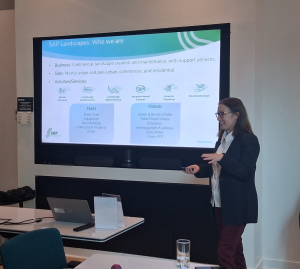
Woman speaks at large screenshowing text in blue boxes and small icons

Under the Corporate Sustainability Reporting Directive (CSRD), Taskforce on Nature-related Financial Disclosure (TNFD) and other guidance such as the Global Reporting Initiative (GRI) and ACT-D, (Assess/Commit/Transform/Disclose), stakeholder engagement is essential for a thorough Double Materiality Assessment process, and critical to any business’ local and global reputation. We were fortunate to have Janice Leonard of SAP Landscapes, above, a business in the next track up, Strategy, present her own journey through DMA and stakeholder engagement, bringing a real-world / learning-by-doing perspective. The SAP Landscapes journey is inspiring, and we all benefited from Janice’s insights, which included the need for steady dedication and the benefits of drawing on the Business for Biodiversity Ireland community within the Nature Strategy Accelerator Programme.

While there is a steep learning curve for many businesses in building awareness and understanding in relation to biodiversity and ecosystems, and the role business is poised to play in driving Nature Positive ambition, Business for Biodiversity Ireland is a reliable support to help businesses of every size and sector work through inter-connections and complexities.

Thanks to all our Action Track businesses for their generosity in sharing their own journeys and we look forward to working with you on the Strategic next phase. Thanks to SAP Landscapes, CIÉ, CIÉ Tours, Cloud Assist, Dublin Airport Authority, FuturEnergy Ireland, Irish Rail, Irish Trees, Scott Cawley Ltd, Shannon Airport, Trinity College Dublin and Watermark.

Following on from earlier Strategy Track workshops, where we focused on the key elements of what a Nature Ambition Statement is (and why every organisation should have one!) and how to set SMART nature targets, BFBI Business Programme Lead Dr Catherine Farrell CIEEM, Trinity College Dublin, writes on the final in-person workshop of 2025 for our businesses in this track where we outlined how to bring all the different components together.

In our first workshop of the year, we outlined the need for in-depth understanding of our business impacts and dependencies on nature, and importantly, where these occur along the business value chain. Armed with insights to our value chain and following the steady guidance of the ACT-D framework  (along with resources such as the WWF Corporate Nature Targets publication, and the Science Based Targets Network framework (with lots of great resources / videos), we began to think about targets.

But, exploring the idea of targets unlocks a whole suite of ensuant questions – should our targets be based on actions or outcomes; resources applied or timeline to get there; and which part of the value chain should we focus on?

Our advice? Stop, take a deep breath and focus on one impact to start with. What could we do to enhance biodiversity at our direct operations? Could we then look further and think about procurement of raw materials – could we set a target to work with our suppliers and collaborate to reduce impacts / drivers of biodiversity loss at source?

Once we start exploring and collaborating, the innovation begins. And innovation is what drives sustainable business forward, to future proof and avoid nature related risk.

The challenge then lies in monitoring and reporting: rather than re-invent wheels take a practical approach and measure what matters, where; and build from there. In our workshop, we explored natural capital accounting methods to build information – showing how knowledge of the stocks and flows help inform decision making and importantly transition planning. Checking how we communicate these targets relative to our Nature Ambition Statement will help to keep us on course.

The team at Business for Biodiversity Ireland extend their gratitude to the Sustainable Futures team at KPMG; thanks also to our hosts Bank Of Ireland, for looking after us at their Baggot Street Head Office. As previous, we followed the guidance for the accelerator programme for businesses set out by Business for Nature under the Commit phase of their ACT-D framework.

Join the Nature Strategy Accelerator Programme for 2026! Sign up on our site or contact our Business Development Manager Dr Maria Fitzpatrick to discuss the options for your business: manager@businessforbiodiversity.ie


What are your business’s impacts and dependencies on nature? What are the potential risks in your supply chain from nature loss and climate issues? The third Business For Biodiversity Ireland Discovery Track webinar of 2025 is coming on Wednesday, September 24, and will address how to tackle these questions when it comes to your business decisions.

Discovery webinars are free to all BFBI subscribers – sign up today to register for this and future Discovery webinars to learn more about the crucial issues facing Irish businesses in the evolving sustainability landscape. The Discovery Track, the first step on our 4-Track Nature Strategy Accelerator Programme, is free to join for guidance on the evolving frameworks and stategy you need to ensure business resilience and longevity.

This Teams webinar (from 9.30am to 10.20am) will cover how the ACT-D Framework (Assess, Commit, Transform & Disclose) is a vital tool for assessing your business’s impacts and dependencies on nature, including upstream and downstream value chain relationships. The framework is aligned with current global best-practice from Business for Nature, Capitals Coalition, WBCSDTNFDScience Based Targets  Network, WEF and WWF.

Register here (and find past and future Discovery webinars and curated resources in the members menu): Join the Discovery Track