BFBI Business Programme Lead Dr Catherine Farrell CIEEM, Assistant Professor in Business and Nature at Trinity College Dublin, writes on emerging nature-related disclosure requirements and how stakeholder engagement is a key process step in building collective understanding for business and nature, as workshopped with businesses in our Nature Strategy Accelerator Programme, delivered in collaboration with the Deloitte WorldClimate team.
“It was a beautiful autumn day when our group met in the Deloitte offices in Dublin’s city centre for the last of our three Action Track workshops that focused on the assess phase of the ACT-D framework. In our first workshop, our keen focus was on building an understanding of our value chain – what we do, where – and how that impacts on nature and, importantly, how much we depend on nature.
Too often businesses are experiencing chinks in the flow of essential components of their supply chains due to a fault in a lengthy global chain, with many of those faults related to climate and biodiversity related risks. If we understand these aspects, we can begin to address ways (opportunities) to mitigate those risks.
The next step is to take a metaphorical LEAP (literally: Locate, Evaluate and Assess our impacts, dependencies, risks and opportunities, and then Prepare to report) and draw a map whereby we can begin a deeper dive and evaluate and assess those dependencies, risks and impacts.
But as we draw that map, we must take time to draw out what stakeholders matter, where, and why. Thanks to the Deloitte team for outlining key stages in a stakeholder engagement and communications plan. Stakeholder engagement isn’t just an option – it’s fundamental to being part of a global community, expressed through global and local links in our value chain.
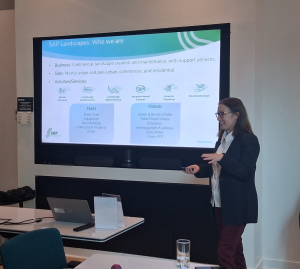
Under the Corporate Sustainability Reporting Directive (CSRD), Taskforce on Nature-related Financial Disclosure (TNFD) and other guidance such as the Global Reporting Initiative (GRI) and ACT-D, (Assess/Commit/Transform/Disclose), stakeholder engagement is essential for a thorough Double Materiality Assessment process, and critical to any business’ local and global reputation. We were fortunate to have Janice Leonard of SAP Landscapes, above, a business in the next track up, Strategy, present her own journey through DMA and stakeholder engagement, bringing a real-world / learning-by-doing perspective. The SAP Landscapes journey is inspiring, and we all benefited from Janice’s insights, which included the need for steady dedication and the benefits of drawing on the Business for Biodiversity Ireland community within the Nature Strategy Accelerator Programme.
While there is a steep learning curve for many businesses in building awareness and understanding in relation to biodiversity and ecosystems, and the role business is poised to play in driving Nature Positive ambition, Business for Biodiversity Ireland is a reliable support to help businesses of every size and sector work through inter-connections and complexities.
Thanks to all our Action Track businesses for their generosity in sharing their own journeys and we look forward to working with you on the Strategic next phase. Thanks to SAP Landscapes, CIÉ, CIÉ Tours, Cloud Assist, Dublin Airport Authority, FuturEnergy Ireland, Irish Rail, Irish Trees, Scott Cawley Ltd, Shannon Airport, Trinity College Dublin and Watermark.