Business for Biodiversity Ireland (BFBI) was invited to attend the in-person and semi-virtual European Business and Nature Summit (EBNS) in Milan on the 11th and 12th of October 2023. BFBI’s Platform Development lead Lucy Gaffney and researcher Emer Ní Dhúill attended the summit – Europe’s foremost high-level political and technical forum, dedicated to mobilising the business community towards achieving the nature-positive goal – and returned with some key takeaways:
On Day 1, the BFBI team attended the Opening Address by EU Commissioner for the Environment Virginijus Sinkevicius, as well as the inspirational keynote by Climate Scientist and Explorer Gilles Denis, also the high level policy and business dialogues and a number of workshop parallel sessions. In addition, the team attended a side event facilitated by KPMG Italy and moderated by Orlaith Delargy of KPMG Ireland, which focused on CSRD and included a guest speaker from the sustainability team at Italian Coffee company Illy Caffe.
Workshop: GBF’s Target 15 as a catalyst for action
“Target 15. Businesses assess and disclose biodiversity dependencies, impacts and risks, and reduce negative impacts” (Kunming-Montreal Global Biodiversity Framework (GBF), Convention on Biological Diversity)
Target 15 of the Global Biodiversity Framework places nature conservation on equal footing with both profit and climate change by exhorting businesses to disclose their dependencies on and impacts to biodiversity. Yet achieving the promise of Target 15 will require new processes and tools. This session explored three such critical areas: how can companies use transition plans to accelerate progress on both nature and climate goals, how can financial institutions take responsibility and amplify this essential work, and how can Target 15 complement and improve the Paris Agreement’s stocktake of progress on climate goals?.
Key Takeaways:
This workshop included a panel discussion on business finance and government, including the need for alignment with financial flows. This session included speakers from the European Commission, the French Treasury, Orkla ASA, and Arcadis.
The need to redirect capital flows was mentioned, in particular that it should include public and private capital. It was highlighted that those who are the custodians of nature should be rewarded. The need to avoid and reduce negative impacts on nature was noted as a key part of Target 15 – ‘you can’t just restore nature, you must reduce and avoid impacts’.
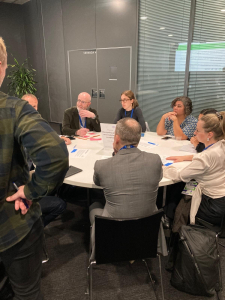
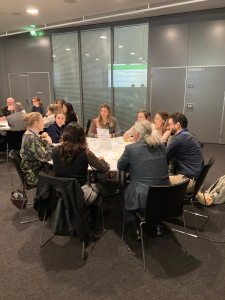
Participants were divided into groups to discuss Target 15. Points raised included:
- The link between biodiversity loss and climate change should be clearly stated, including an understanding that actions for biodiversity can mitigate the impacts from climate change.
- Nature must be integrated with climate – this includes the synergies and trade-offs.
- There is a need for transformative change to nature positive in order to achieve Target 15.
- There is a need to disclose impacts and dependencies, but actions should also be disclosed.
- Transition plans need to be well thought out, transparent, and identify action gaps.
- The need to data standardisation was highlighted.
- The timeline for Transition Plans was discussed, with it generally agreed that they should have long-term actions (at least to 2050), but in reality, the duration is short-term.
- For nature, the location/landscape level is important for setting nature-positive goals. The sector level works well for climate action, but for biodiversity, the landscape level is more important. However, a good high-level starting point is the Sector Actions Towards a Nature-Positive Future developed by Business for Nature.
- Although the location/landscape level for nature was considered important, it was highlighted that investors invest in sectors, not locations/landscapes. Consideration needs to be given to this and how to get investors to change that mindset – with a suggestion that investors go back to their clients and inform them of the need to assess impacts and dependencies at the location/landscape level along the value chain of a given portfolio.
- The need to look at companies within sectors and what they doing was noted, with the aim of separating the leaders from the laggards.
Creating a credible roadmap to a nature-positive economy: how to avoid green-washing and ensure real outcomes for biodiversity
The session provided introductory information for businesses to action nature-positive ambition now. Providing real-world examples of actions being taken by leading corporations, with a focus on setting organisational biodiversity targets, measuring and accounting for impacts, and working to improve value-chain transparency. This session included speakers from Etifor, Fauna & Flora, BancaEtica, Salesforce, NextEnergy and NESTE and was moderated by Wesley Snell from Etifor.
Key Takeaways:
- Businesses need to understand how they interact with commodity markets.
- There is an understanding that we cannot eliminate harm completely, but that we need to operate within planetary boundaries
- Biodiversity only applies to Scope 1 and 3
- There is a general lack of biodiversity knowledge in the business community
- There are key mindset challenges that exist in business
- Getting internal buy-in can be a real stumbling block.


On Day 2, the BFBI team attended the opening address by Florika Fink-Hooijer, EC Director General for the Environment, the high-level policy and business dialogue 3 and a number of workshop sessions, as well as the closing plenary.
Sector transition pathways to nature positive
Following the adoption of the Global Biodiversity Framework, various business initiatives including Business for Nature (BfN), WBCSD and WEF have started identifying a set of sector-specific actions that business can take to contribute to a nature positive future. Drawing on the outcome of this work, this session identified common barriers and challenges currently preventing business action and impeding sector transition. As the momentum around business and biodiversity continues to increase globally, the session also identified policy levers to accelerate and scale up nature-positive sector transformation and opportunities to finance business innovations and models across the economy that protect and restore nature.
Moderated by Eva Zabey, CEO of Business for Nature, this was an audience-led session and after some brief panel questions, discussion was thrown out to the floor. The topic was “challenges facing businesses when it comes to taking or scaling action”. BFBI’s Lucy Gaffney intervened, stating that one of the main challenges involves dismantling the current ideals and thinking around corporate biodiversity actions, traditional activities like wildflower meadows and beehives, and rebuilding corporate perspectives around biodiversity strategies. The intervention was well received and prompted numerous conversations at the networking break.
Business for Nature announced a new campaign called “It’s Now for Nature” launching on November 9th, a rally cry to business to act on nature and contribute to nature positive world by 2030.
Biodiversity certificates and credits: an opportunity for forests, coastal habitats, and local communities?
Biodiversity credits and certificates offer a chance to accelerate the transition to a nature-positive society. All actors and market participants need to be involved in the design of emerging biodiversity schemes, understanding the challenges and conditions for developing a high integrity and scalable voluntary biodiversity credits framework that supports business in their journey towards nature positive. The session aimed to showcase emerging initiatives in this space, focusing on measuring, certifying, and trading of credits. By gathering different viewpoints from policy, science, and business, the session aimed to help demonstrate the multiple forms of expertise that are needed.
Key Takeaways
This session included speakers from ItaSIF – Forum per la Finanza Sostenibile, World Economic Forum, CDC Biodiversité, European Commission Joint Research Centre, NatureMetrics, Forest Stewardship Council International (FSC) and Etifor. Key takeaways from this session:
- Biodiversity credits are not a silver bullet and not the solution to the biodiversity loss crisis – however they are an important and useful tool that can be employed.
- Other mitigation measures need to be implemented before considering biodiversity credits.
- Biodiversity credit claims need to be realistic and need to protect consumers from greenwashing – the Green Claims Directive was highlighted.
- The TNFD and SBTN guidance were mentioned as important resources.
- There is a need for standardised, verifiable data, including data on impact reductions and finance data.
- There is a need for pressure data and on-the-ground data.
- Data needs to be stored to be available long-term (aka a data hub).
- Metrics for ecological equivalence similar to those of carbon equivalence are needed.
- Criteria need to be measurable (carbon farming was mentioned).
- Biodiversity is location specific, the metrics used in one location may not be appropriate for another location – this is a challenge.
- Tools developed for nature metrics need to be aligned to the stakeholders needs/ability. However, there is a cost associated with developing such tools (i.e. NatureMetrics).
- It was highlighted that there are numerous biodiversity credit standards but only a handful of projects.
- Offsetting should be regulated, not voluntary.
Transforming the global food system: Establishing successful partnerships to engage all actors in the value chain
This session focused on tested tools and approaches for creating and maintaining successful inclusive value-chain collaboration to reach agrobiodiversity objectives in different contexts. Speakers included representatives from Nestle, Lidl, the Italian Farmers Association, the Cool Farm Alliance and Coldiretti Bio.
Key Takeaways
- Food is an ecosystem service, biodiversity is the lubricant
- The latest CAP is designed for productivity but some money is earmarked for climate and biodiversity
- Businesses must focus on reducing negative externalities, reducing food loss and waste, educating consumers
- Less nature = less food
- Food is big business in Europe. The growing global population is putting huge pressures on food systems.
- Farmers need to be part of the conversation – most farmers (in Italy) are small farmers with limited time and resources (this would hold true for Ireland too)
- There is a need for common targets such as the EU Green Deal (EU Biodiversity Strategy and Farm to Fork) targets for reducing pesticide use
- There is a legislative framework on food in progress at the EU Commission which focuses on soil health (soil underpins all sustainability in the food sector)
- A big strength of food security is the ecosystem services provided
- Tech drives investment, but eco-tech (including Nature-based Solutions) are also important
- The EU are the standard setters and have influence on the global stage
- Regarding the Nature Restoration Law, it was noted that some stakeholders feel threatened although the aim of the NRL is for the benefit all stakeholders.
BFBI platform lead Lucy asked a question around a 2020 UNEP report which states that the business models of primary producers will be more likely to shift towards nature positive if the value chain pays for the outcome. How likely are businesses within the value chain to finance their upstream primary producers to become more nature positive and how can we mobilise finance from within the value chain instead of consistently relying on the public purse?
Conclusion
The 2023 summit was about turning commitments into action and catalysing business activities that will support the Global Biodiversity Framework. There were certainly more businesses in attendance compared to 2022 and there were many examples of businesses taking action illustrated throughout the workshop sessions. The European Commission also had a larger delegation this year.
Several interventions were made by the BFBI team which highlighted our platform and our team. The opportunities for networking were vast and BFBI made some very important connections that will enhance our offering to business in the future by having access to experts and business examples that are well on their way to becoming nature positive.

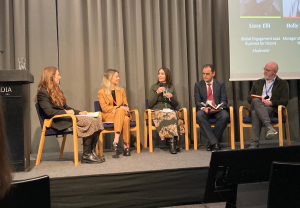
 Horizon Nua Director Siobhan McQuaid moderated the discussion on ‘Rationale and roadblocks for business transformation to nature positive’ while launching the TF3 EC Expert publication which features new research and case studies from over 40 EU-funded projects. Co-authored by Siobhan and Horizon Nua EU Project Manager Martina Brophy, it sets out both the reasons and challenges for nature-positive transformation from a business and policy perspective. Access the new publication HERE.


