Goal A3: Step 2

Standardise your Reports

Why standardise reports?

From the need to safeguard marine habitats to responding to pressures on natural resources and growing inequality, our world faces significant economic, environmental and social challenges. By doing business in a way that aligns long-term strategies with care for people and planet, organisations can play a crucial role in sustainable development and contribute to a nature positive future.

Standardised reporting frameworks help organisations increase their transparency and communicate their sustainability initiatives, impacts and dependencies. By better understanding, managing and disclosing impacts and dependencies, organisations can unlock benefits that inform decisions, reduce risks, improve business opportunities and strengthen stakeholder relationships. This, in turn, enables companies to demonstrate their contributions towards environmental stewardship and societal wellbeing.

This guidance document – Goal A3- relates to the reporting aspect of your journey to nature positive . It focuses in particular on preparation for reporting under the Corporate Sustainability Reporting Directive (CSRD) but is also useful if you are considering reporting voluntarily.

An Overview of reporting standards

The following section will give you an overview of the reporting standards that are internationally recognised and aligned with each other. Read through the list to get an idea of what each one can offer. Companies need to assess their impacts and dependencies on nature; measure, value and prioritise their impacts and dependencies on nature; and ensure they are acting on the most material ones.

A note on “Materiality”

Materiality is a concept that determines whether the omission or misstatement of information in a financial report would impact a reasonable user’s decisionmaking. If information is significant, it is material. If the information is insignificant or irrelevant, it is said to be immaterial

Standard and frameworks?

Organisations that publish standards, and ones that publish frameworks, and ones that do both (intersection of Venn). Image from The GRI Perspective, published 10th March 2022.

GRI – Global Reporting Initiative, EFRAG – European Financial Reporting Advisory Group, ISSB – International Sustainability Standards Board, SASB – Sustainability Accounting Standards Board, IASB – International Accounting Standards Board, OECD – Organisation for Economic Cooperation and Development, IFC – International Finance Corporation, TCFD – Taskforce on Climate-related Financial Disclosure, PCAF – Partnership for Carbon Accounting Financials. CDP – Carbon Disclosure Project, WBCSD – World Business Council for Sustainable Development, PRI – Principles for Responsible Investment

Assessment frameworks help you to understand what you need to report on.
Reporting standards show you how to report.

Making the link

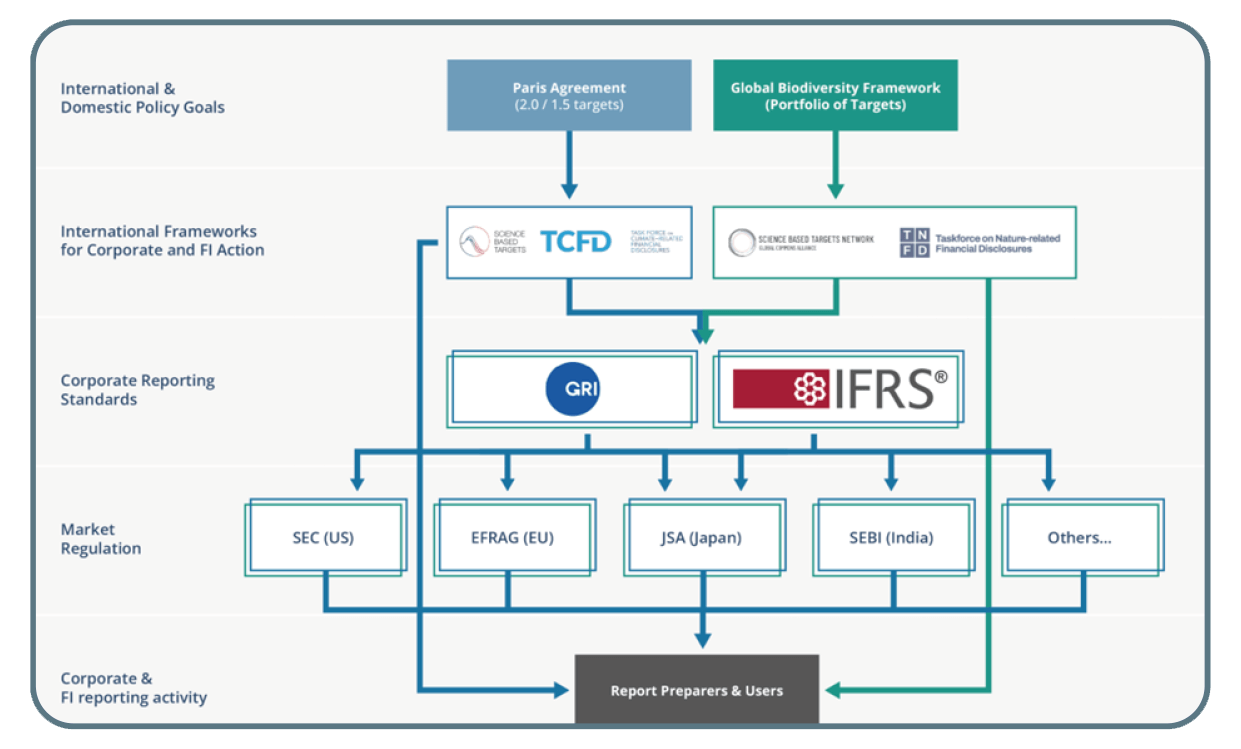
Let’s look at how the different policies, frameworks and standards are linked. The diagram below is a useful infographic developed by the Taskforce on Nature Related Financial Disclosures (TNFD) showing the emerging reporting architecture (TNFD, 2023).

Showing the relationship between international and domestic policy goals; international frameworks for corporate and financial action; corporate reporting standards; market regulation; and, corporate and finance reporting activities. Image from TNFD beta framework, v0.4 (TNFD, 2023), IFRS – International Financial Reporting Standards

Reporting Standard Recommendations

Click on the relevant link below:
(The number in brackets refers to your headcount)